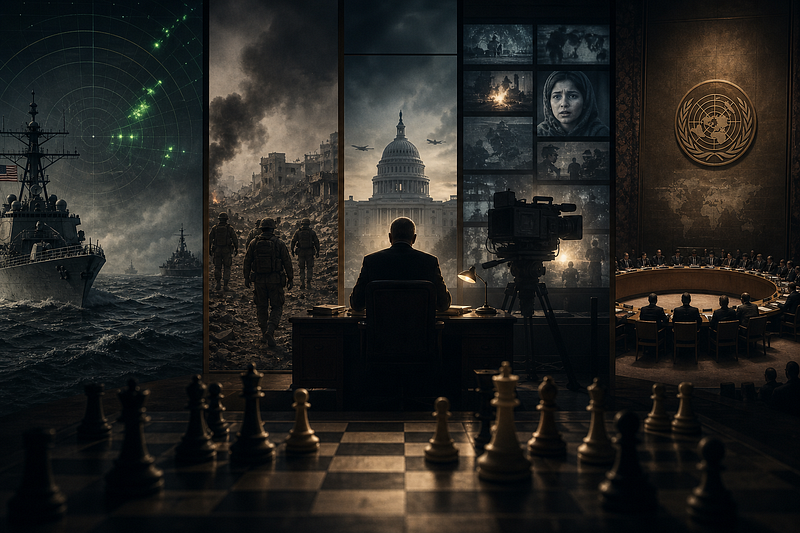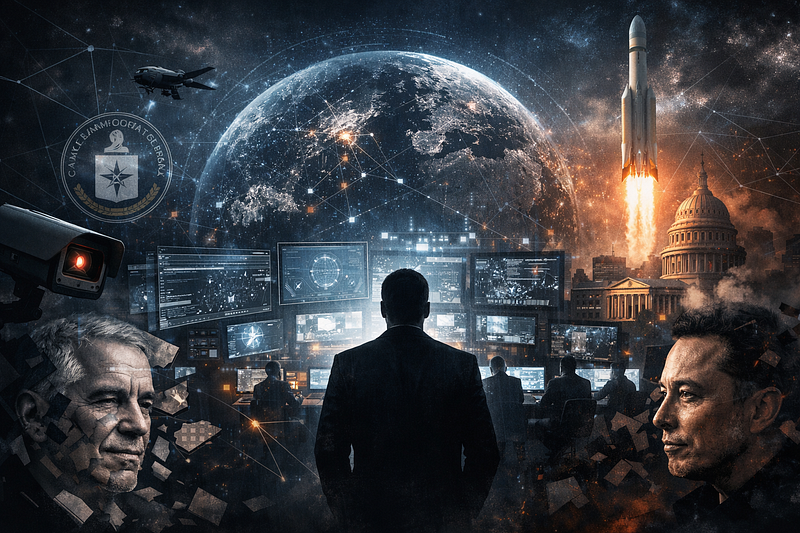
Most people don’t know what Palantir is. This article explains why that matters, and how systems like it are quietly reshaping power, AI, and decision-making.
There are moments in history when power changes form quietly, before the public has found the language to describe it.
By the time most people realize what has happened, the system is already in place.
That moment may be now.
Because while the world is still focused on faces, something else has taken shape beneath them. Not a person, not a scandal, not even a single institution, but a system.
The public still looks where it has been trained to look, toward individuals. Toward scandals, elections, billionaires, and the figures who dominate attention long enough to feel like power itself. Elon Musk does. Donald Trump certainly does. Jeffrey Epstein only entered that space once his network collapsed into public view, while institutions like the CIA have long operated in that darker territory where influence and secrecy overlap.
These are the points where attention naturally settles.
They suggest that power can be located, observed, and eventually understood.
That assumption is becoming less reliable.
Palantir operates in a different layer.
For many readers, the name still means almost nothing. It does not belong to daily life in the way Google, Apple, Amazon, or OpenAI do. It is not something you install or interact with. It exists elsewhere, closer to the machinery that actually governs things.
That difference is what makes it significant.
Because the most consequential shifts of an age rarely arrive with noise. They emerge quietly, wrapped in technical language and embedded in systems that appear administrative rather than political. By the time the public understands the scale of what has been built, the architecture is already in place.
This concerns you, even if you have never heard the name before.
Systems like this do not remain confined to intelligence agencies or military commands. Once they prove useful, they spread into borders, finance, infrastructure, and into the way institutions classify risk, track movement, and decide what matters.
And once that happens, the consequences no longer stay abstract.
A traveler can be delayed at a border without explanation, not because an officer is improvising, but because a system has already marked the profile as requiring attention. A financial transaction may be flagged not because it is illegal, but because it resembles a pattern the system treats as risk, while a name that appears across multiple databases may mean nothing in isolation, yet together forms a signal strong enough to trigger action.
Nothing is announced. Nothing is explained. Yet something has already been decided upstream.
That is the shift.
The public still watches faces. The real transformation is happening in systems.
What Palantir Is, and Why That Definition Hides the Real Story
Palantir is often described as a data analytics platform, but that definition explains very little about what it actually does.
It builds software used by governments and institutions to organize data, improve visibility, and support decision-making. All of that is true, and yet none of it explains why it matters.
Because the language surrounding systems like this is designed to make them appear smaller than they are. Procedural. Technical. Necessary. The more consequential the system, the more neutral it sounds.
Palantir does not simply store information. It connects it.
What once existed as fragmented data begins to form relationships. Identity becomes linked to movement, movement to communication, communication to networks, and those networks to financial flows, logistics, and behavior. The result is not just more information, but a new kind of visibility.
Information no longer merely describes reality. It begins to organize it.
A system does not need to accuse you to affect you. It only needs to define you.
Institutions do not collect data out of curiosity. They collect it to reduce uncertainty, to see faster, and to act sooner. Palantir sits precisely at that intersection, not where technology entertains or connects, but where institutions attempt to understand and control complexity.
It is not designed to be visible. It is designed to be relied upon.
And once a system becomes indispensable, it stops being software.
It becomes infrastructure.
That is the deeper turn.
A spreadsheet records. A dashboard displays. A platform like Palantir helps institutions construct an operational picture of reality. It does not just gather information. It helps determine what becomes legible enough to matter.
That sounds technical until you realize what it implies. A system that changes what can be seen also changes what can be acted upon. A system that organizes visibility begins to organize authority. That is where the conversation stops being about software in the ordinary sense and starts becoming political in the deepest one.
What you are seeing is a transition from personal leverage to infrastructural control.
From Hidden Files to Living Systems
To understand why systems like Palantir matter, you first have to understand what they are replacing.
Jeffrey Epstein only became visible once his network collapsed into public view, but what he represented was not unique. He belonged to an older architecture of power, one built on proximity, access, and vulnerability. Control in that world depended on what could be known about a person, what could be held back, and what could be revealed at the right moment.
Influence moved through relationships, secrets, and carefully managed exposure.
It was effective.
But it depended on people.
And that dependence made it unstable.
A system built on intermediaries is always at risk of breaking. People talk, defect, panic, disappear, or miscalculate. A single exposure can unravel an entire network. A file can leak. A broker can become a liability. A compromised operator can turn a hidden architecture into a public scandal overnight.
That fragility created a need, not for less control, but for more stable control.
A hidden file waits, while a living system updates. A hidden file contains leverage, while a living system generates it.
What used to be hidden in files is now distributed across infrastructure.
A figure like Epstein makes sense in a world where power depends on what is hidden and who controls access to it.
A system like Palantir belongs to a different world.
Not one where secrets disappear, but one where they no longer need to be held in the same way. Visibility becomes continuous, patterns replace isolated files, and control no longer depends on a single intermediary.
The CIA represents the institutionalization of that earlier logic, where information becomes structured power, but still moves through human networks rather than fully integrated systems. Intelligence services have always wanted to know before others know, to connect before others connect, and to act before others fully understand what is happening. What changes in the digital age is not that desire, but the scale at which it can be fed.
This is where the older world begins to mutate.
The intimate architecture of leverage does not vanish. It gets absorbed into a more durable environment. What once required handlers, archives, memory, access, and silence can increasingly be stabilized through integration, classification, and continuous machine-assisted visibility.
Power no longer needs to wait for the right moment. It operates continuously, through patterns, thresholds, and classification, often long before a subject even understands what is happening.
This marks the transition from episodic control to continuous control.
And continuous control is not merely a stronger version of the old world. It is a different one. It does not always need the drama of exposure. It does not always need a compromising photograph, a whispered threat, or a black file in a locked room. It can work much more quietly, through a system that never fully stops watching and never fully stops recalculating.
The old architecture of control had a room, a file, a voice, a face.
The new one looks like software.
When Seeing Starts to Merge With Deciding
Most people still imagine that systems provide information while humans make decisions. That distinction is becoming harder to maintain.
A system does not need to make decisions to influence outcomes. It only needs to shape what becomes visible, what rises to attention, and what is treated as risk.
By the time a human signs anything, the terrain has already been prepared.
What makes this shift difficult to recognize is that nothing appears to have changed. The same institutions still exist, the same procedures are followed, and the same decisions are signed by human hands.
But something fundamental has moved.
The decision no longer begins where it appears to begin. It begins earlier, in the system that determines what is visible, in the model that defines what matters, and in the architecture that decides what becomes a problem.
The system does not replace human judgment. It quietly reshapes it.
By the time a person acts, the system has already shaped the reality they are responding to.
This is what makes the shift so difficult to see in ordinary political language. The same titles remain. The same signatures remain. The same offices remain. Yet the field of relevance has already been narrowed before the human being arrives at the point of visible choice.
The system does not just change how decisions are made. It changes what is knowable in the first place.
That is a deeper transformation than most public debate is prepared to handle.
The issue is not simply that institutions know more than before. The issue is that they begin to know in a way that is already structured for intervention. A cluster becomes suspicious. A pattern becomes urgent. A profile becomes actionable. Even if no one says it aloud, the architecture has already begun to define what kind of response feels reasonable.
Once institutions begin to rely on systems like this, stepping back becomes harder than moving forward.
Because the promise of these systems is seductive. They reduce uncertainty. They speed up classification. They make complexity feel manageable. They create the impression that if only the institution can see enough, it can govern more effectively.
That is not a trivial promise.
It appeals to bureaucracies that fear disorder, to militaries that fear delay, to intelligence services that fear surprise, and to governments that increasingly feel overwhelmed by the scale of modern complexity. Under those conditions, a platform that appears to connect the fragments into one coherent picture does more than assist. It becomes tempting as a worldview.
And that is where the danger deepens.
Not Different Stories, But One Evolution
The presence of names like Epstein, Musk, the CIA, war, AI, and Palantir can create confusion. They seem to belong to different domains and different stories.
But that impression only holds at the surface.
Each reflects a different stage in how power evolves.
Epstein reflects control through personal vulnerability.
The CIA reflects control through institutional knowledge.
War forces acceleration and integration.
AI removes the limits of scale.
Musk represents the visible face of technological infrastructure.
Palantir is where these forces stabilize into systems.
Not different stories that happen to intersect, but one story that changes form.
This is not about a single company or a single network, but about a broader shift in how modern systems operate.
That is why the title matters. Not because it claims these figures are identical, and not because it collapses everything into one blunt theory. It matters because these names function like markers along a changing route. They show the movement from one mode of power to another.
From secrets held by people to patterns held by systems.
From selective leverage to scalable legibility.
From dramatic exposure to quiet architecture.
This is also why the argument has to be made with care. The claim is not that Palantir is “the same as” Epstein, or that one founder or one agency explains the whole age. The claim is that the deeper mechanism changes form while preserving its function. Control remains the goal. The means become colder.
Once you see that, the apparent sprawl of the subject narrows into one line.
The line is not between good people and bad people.
It is between older and newer forms of organized power.
Why War, Intelligence, and AI Accelerate Everything
War removes hesitation, intelligence reduces uncertainty, and AI removes limits. Together, they create systems that do not simply react, but anticipate.
A transaction can be flagged before it becomes a problem, a movement tracked before it appears suspicious, and a person quietly categorized long before they realize they have already been defined.
Control no longer depends on knowing everything. It depends on knowing enough, faster than anyone else.
The emergency introduces the system. The system remains after the emergency has passed.
War matters here because it lowers the threshold for adoption. Under pressure, speed becomes virtue. Delay becomes weakness. Scruple becomes friction. Systems that might once have seemed invasive are reframed as necessary. What matters is not whether the emergency lasts forever. What matters is that once the system proves useful inside the emergency, it rarely remains confined to it.
This is one of the deepest habits of modern governance.
A system justified on the battlefield migrates into administration. A capability introduced for intelligence purposes expands into border management, logistics, finance, policing, infrastructure, and public order. What was first accepted as exceptional becomes routine. What was once extraordinary becomes procedural.
This is why war, intelligence, and AI form such a powerful triangle.
War creates urgency.
Intelligence creates motive.
AI creates scale.
And once scale enters the picture, the institution begins to imagine a world in which human limitation itself becomes the problem. Local judgment is too slow. Human interpretation is too inconsistent. Ambiguity becomes intolerable. The system begins to appear not just useful, but preferable.
That is a dangerous preference.
Because once institutions prefer system-legibility over human ambiguity, they begin to reorganize the world around what can be measured, tracked, correlated, and acted upon. The unclassifiable becomes suspicious. The friction of ordinary human life starts to look like inefficiency. The institution slowly begins to believe that because a pattern can be detected, it ought to be governed through that pattern.
That is not merely technological change.
It is a change in administrative instinct.
Why This Concerns You
This extends beyond geopolitics.
It is about how systems begin to see people.
A person becomes a profile, a profile becomes a pattern, and that pattern increasingly informs decisions made elsewhere.
You are not only seen when you are watched. You are seen when the system decides you matter.
A delay, a flag, or a classification may appear isolated, but together they form part of a broader shift in how reality is interpreted and acted upon.
This is the part most people are still least prepared to think about.
They can imagine surveillance. They can imagine a camera. A database. A checkpoint. But the deeper question is what happens once separate systems begin speaking to one another and once their conclusions begin traveling faster than the person being described.
A traveler stopped because of a pattern attached to a profile. A payment delayed because it resembles a class of risk. A name that acquires weight not through anything dramatic, but because multiple systems silently agree that it deserves attention. These are not cinematic scenes. That is precisely why they matter.
The system does not need to understand you. It only needs to recognize you well enough to act.
That is colder than older forms of control.
Older power often needed intimacy. It needed to know your weakness, your appetite, your fear, your compromise. The newer architecture can operate with less intimacy and more abstraction. It does not always need to know who you are in a rich human sense. It only needs a sufficient statistical likeness, a threshold, a pattern, an anomaly, a category.
And once that becomes normal, the burden shifts.
It is no longer on the system to justify why it watched.
It becomes the burden of the person to prove that the pattern attached to them is incomplete, misleading, or wrong.
That is a profound political inversion.
It means ordinary people increasingly move through a world in which they are interpreted before they are heard.
The Most Dangerous Part Is Not Abuse, but Normalization
The greatest risk is not misuse, but acceptance.
A system becomes standard, a workflow becomes normal, and a classification becomes unquestioned. Over time, what once required justification begins to feel natural.
More visibility leads to more integration, and more integration leads to deeper dependence, often without a moment where anyone explicitly agreed to the change.
This is what makes the subject so difficult.
People still expect danger to announce itself dramatically. They expect an obvious violation, an overt abuse, a scandal large enough to trigger resistance. But the deeper threat is often quieter. It is the point at which a society stops noticing the political meaning of systems because those systems have already been absorbed into ordinary procedure.
That is how eras change.
Not necessarily through one rupture, but through a slow redefinition of what feels normal. A system enters through the language of necessity. It remains through the language of efficiency. It deepens through the language of routine.
And eventually the public no longer asks whether such a system should exist. It asks only how to live around it.
That is a much more dangerous form of victory than open force usually achieves.
Because what has been normalized rarely appears as domination, even when domination has become its quiet function.
The Quiet Power Shift
Power has moved, quietly but decisively, from people to systems, from secrets to visibility, and from leverage to infrastructure.
Power no longer needs to knock on the door. It is already inside the system that decides whether the door opens.
By the time a system becomes visible, it is already too integrated to remove without consequences.
Once that shift is far enough advanced, the question is no longer who rules.
It becomes something else.
Through what systems is rule made possible, and how far do those systems shape reality before anyone decides to resist them?
Because by the time that question is asked seriously, the system may already have decided what resistance looks like, and where it is allowed to exist.
What matters now is not to treat Palantir as an isolated subject, but to recognize it as part of a wider pattern. The same pattern runs through war, intelligence, institutional continuity, hidden governance, and the long habit of power surviving by changing form.
This is where the wider map of The Manifest begins to matter.
If this chapter resonated with you, continue with these connected pieces:
NATO: The Façade of Peace and the Architecture of PowerA deeper look at how modern military alliances present themselves as defensive and stabilizing while operating inside a much older structure of strategic control.
Why Rome Never Really FellAn exploration of how institutions outlive empires, and how power often survives by changing form rather than disappearing.
The transition from the USSR to Russia: what really happenedA study in managed transformation, where collapse was less an ending than a reorganization of power under a different surface.
The Hidden Throne: The Vatican’s Absolute PowerA broader chapter on continuity, hidden influence, and the structures that remain standing while the visible world keeps changing above them.
Palantir belongs to that same world.
Not as an accident. Not as a side story. But as one more clue in the architecture this Manifest is trying to make visible.
Follow The Manifest for the next chapter.
This is not a series of isolated essays. It is one unfolding investigation into power, continuity, hidden systems, and the forces shaping the modern world behind the visible stage.
Because the point is not only to expose what is wrong.
It is to learn how to see the structure clearly enough that it can no longer hide behind noise.