You have read about the state visit. You saw the footage. You read that the Dutch king “made the differences clear.” What you did not read, and what no news outlet reported, is that the Dutch delegation spent the four days before the White House meeting in a private conference with the people who shape Western policy. That gap is not an accident. It is what this article is about.
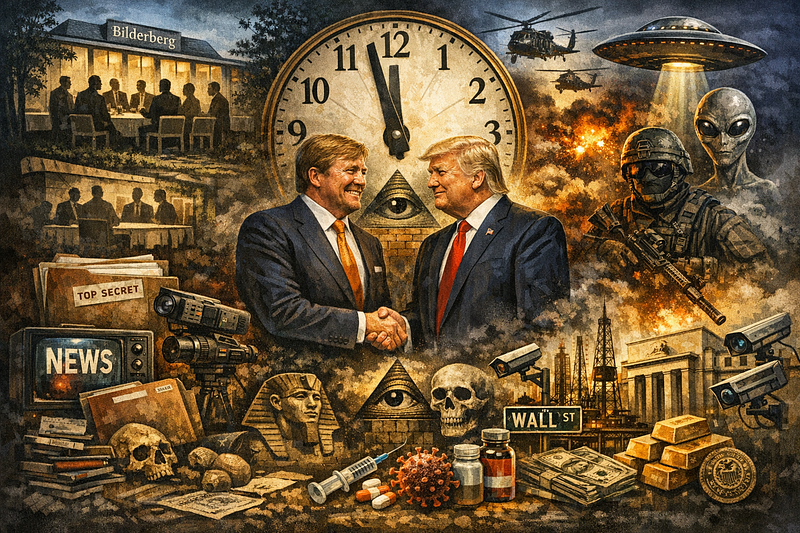
April 9, 2026. Washington, D.C. The Salamander hotel on 14th Street is twelve minutes by car from the White House. For four days, 128 delegates from 23 countries met there in private. No agenda was published. No press was admitted. No minutes were kept. The meeting was the 72nd annual Bilderberg Conference. The rule governing it guarantees that nothing discussed can ever be attributed to anyone who said it.
On April 13, the day after Bilderberg ended, King Willem-Alexander of the Netherlands arrived at the White House for a state visit. Rob Jetten, Dutch Minister of Climate and Energy Policy, accompanied him. Rob Jetten had also been at Bilderberg the previous four days.
The Dutch press called it a diplomatic trip. The American press called it an awkward encounter. No outlet mentioned that the Dutch delegation had spent the preceding four days in a private room discussing the same subjects they would raise with Trump.
Four days. Same city. Same delegation. Different rooms.
What Bilderberg Is
Bilderberg is an annual private conference, held since 1954, that brings together roughly 130 senior figures from Western governments, finance, technology, defense, and media. The participant list is published. The agenda is published in outline. What is not published, and structurally cannot be published, is what anyone says. The Chatham House Rule prohibits attribution. Participants may use what they learn. They may not reveal who said what.
The result is a room where a central bank governor, a defense minister, a technology CEO, and an intelligence official can discuss the same policy question without any public record of who argued what. This is not secrecy. It is the systematic prevention of accountability. The distinction matters, because secrecy can be breached. This architecture cannot.
A forum for off-the-record dialogue, the official description reads. Off-the-record means not attributable. It does not mean uninfluential.
Note what this costs: nothing. No suppression required. No orders given. The architecture produces its own silence.
The Founding Chairman Was an SS Member
Prince Bernhard of the Netherlands chaired Bilderberg from its founding in 1954 until 1976. He had joined the Nazi Party on May 1, 1933, and the SS cavalry unit three months later. His membership card is in the archive. He denied this until his death. In 1976, he was forced to resign after it emerged that Lockheed Corporation had paid him $1.1 million in bribes to secure Dutch military contracts. The payment was documented in his own letter. Queen Juliana threatened to abdicate if he was prosecuted. He was not prosecuted.
Queen Beatrix, his daughter, continued the participation. The published Bilderberg attendance records document her presence at multiple conferences across the 1980s and 1990s. The House of Orange had received a 25 percent stake in Royal Dutch Shell when the company was formed in 1907. The Sunday Times reported in 2004 that the family’s Shell stake was then approximately 5 percent, and that a decline in Shell’s share price had cost the family an estimated 800 million euros. When energy policy was discussed at Bilderberg, the founding family of Shell was in the room.
King Willem-Alexander, Bernhard’s grandson, was on the participant list for the 72nd Bilderberg Conference in Washington, April 9 to 12, 2026.
Three generations. Seventy-two years. The chair rotates. The family does not.
The Dutch Delegation
The Netherlands sent four participants to Bilderberg 2026. For a country of eighteen million people, the composition was precise. Rob Jetten, Minister of Climate and Energy Policy, was present at a moment when the Hormuz blockade had restructured global energy flows and Dutch gas infrastructure was under direct strategic pressure. Sigrid Kaag, former Minister of Foreign Affairs and Finance, now Co-Chair of the United Nations Foundation, had previously served as UN Special Coordinator for Lebanon and Special Representative for Iraq. She was at Bilderberg four days before the Dutch king discussed Iran with the American president.
Roy Jakobs, CEO of Royal Philips, represented healthcare technology and AI governance, both of which were on the documented agenda. Then there is ASML. Peter Wennink, CEO of ASML, attended Bilderberg in 2022 and 2023. ASML produces the only extreme ultraviolet lithography machines in existence. Every advanced semiconductor in the world requires this technology. Only ASML makes it. During those two years, the United States pressured the Netherlands to restrict ASML exports to China. In January 2023, the restrictions were announced.
Whether those discussions shaped the decision is unanswerable by design. That is the point. The Chatham House Rule does not prevent coordination. It prevents documentation of coordination. The outcome is identical. The trail is not. The meeting does not need to issue instructions. It needs only to occur.
The Man Who Was Never Invited
Donald Trump has never been invited to Bilderberg. Not as a developer, not as a candidate, not as president, not as a former president. He does not appear on any participant list across seventy-two years. His people have been there: Kushner in 2019, Pompeo in 2019, McMaster and Ross in 2017. The network admitted his subordinates. It has never admitted him.
On April 13, the Dutch delegation walked out of four days of Bilderberg and into the White House. The man sitting across the table had never been in that room. He had never been invited. The delegation that had spent four days aligning its posture now sat across from the variable that posture was designed to manage.
The awkward moment on camera was not diplomatic tension. It was the architecture meeting the variable it could not control.
What the Silence Tells Us
A more charitable reading would be simpler. State visits are scripted events. Journalists focus on what is said in the room, not on what may have been discussed elsewhere. Bilderberg, in that reading, is treated as background context rather than actionable information. That explanation is plausible. It is also incomplete. Because the overlap here was not subtle. It required no leak, no source, no speculation. It required only the combination of two public facts: a meeting, and a visit. The decision not to connect them was not enforced. It was made.
This is not a conspiracy. The meeting was publicly listed. The participants were named. The dates were known. The proximity was arithmetically obvious. The story was there. It was not told.
Propaganda does not require a propagandist. It requires a structure that makes certain information feel peripheral. The meeting is real. The participants are named. The dates are published. And it is treated, by the institutions whose job is to tell people what matters, as though it does not.
Consider what that silence required. Not a single editor had to be instructed. Not a single journalist had to be pressured. The convention that Bilderberg is “background noise” was sufficient. It was enough that the professional culture of political journalism had, over decades, categorized this kind of proximity as coincidence and this kind of meeting as unserious. No one made that decision. It accumulated. That is what makes it durable.
Three generations of the Dutch royal family have participated in this structure. The grandfather who built it was a Nazi SS member and a paid corporate agent who wrote to Lockheed on royal stationery. The mother who continued it belonged to the family that founded Shell and whose finances moved when energy policy moved. The grandson who attended its 72nd edition sat down with the American president four days later, accompanied by the energy minister and the former foreign affairs minister who had just spent four days in the same building discussing the same subjects.
You read about the state visit. You saw the awkward footage. You read that differences were made clear. The only actor the architecture did not design a role for is the one reading this now.
The Manifest Archive publishes two versions of each analysis. This is the condensed version. The full text, including the complete three-generation institutional continuity analysis, the ASML chip-war connection, the absence map as intervention record, and the structural analysis of Trump as the uninvited variable, is available on Substack. Free to read.