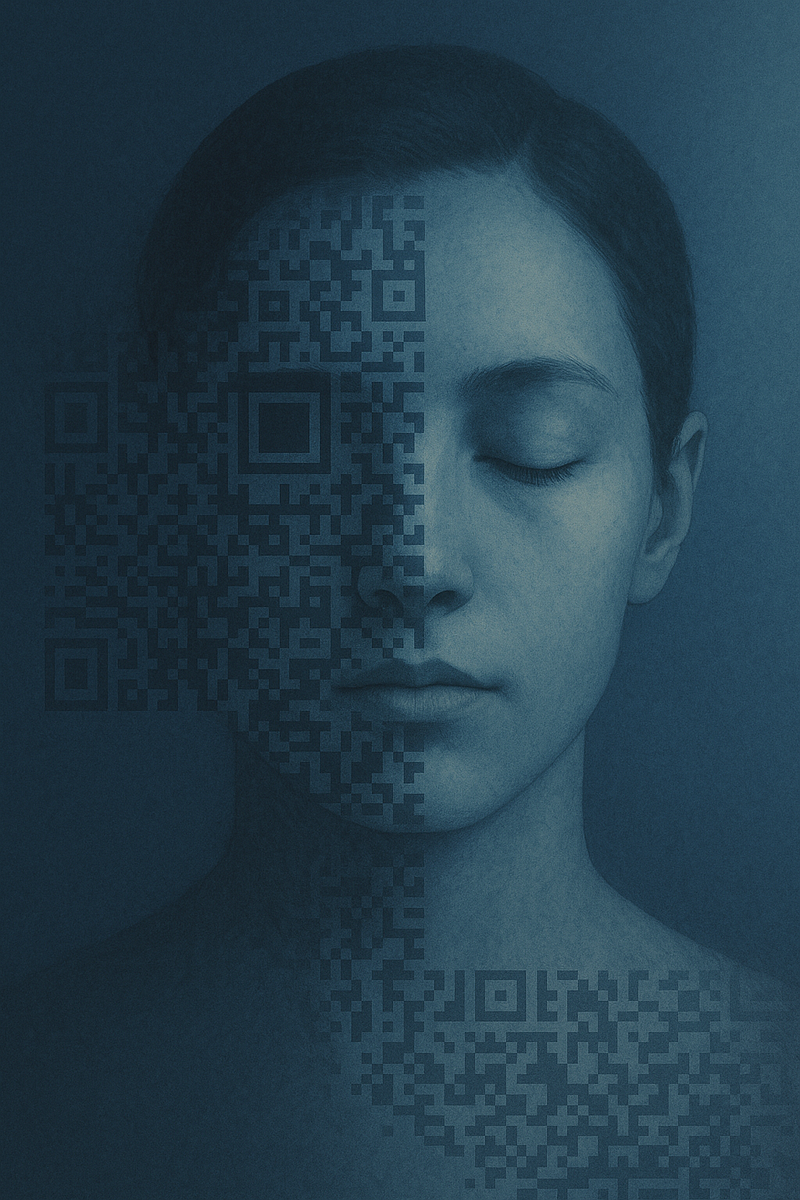
The gate hums. A green light blinks. A face leans toward the glass.
The future no longer asks who you are.
It asks for proof — and soon, that proof will live beneath your skin.
We tap, we scan, we smile.
For now the code sits on a screen, gentle and obedient, but the next design hides in the flesh: a chip no larger than a grain of rice, pulsing quietly beneath the surface, carrying the same number, the same permission.
The gesture feels harmless — a small courtesy to the machine that opens every door.
Yet with each motion we surrender something quiet: the belief that recognition once belonged to people, not programs.
The light changes again. Another person passes through.
The rhythm repeats.
What began as convenience is now the pulse of daily life.
They call it progress. It feels like permission dressed as convenience.
The promise was safety — a digital key to guard our names, our savings, our presence.
But keys have two ends: one that opens, one that locks.
Somewhere between convenience and necessity, freedom became procedural.
Each confirmation replaces a conversation.
Each verification replaces trust.
In meeting halls of glass, the vocabulary of virtue fills the air: inclusion, empowerment, trust.
Charts rise behind smiling speakers, applause flows like background music.
It looks like reason. It sounds like compassion.
When identity becomes data, obedience becomes effortless.
They told us it was for protection, for fairness, for the invisible billion who live without papers or accounts.
The words were generous; the infrastructure was not.
To be included, you must first be recorded.
To be recorded, you must consent to be seen — and, eventually, to be scanned from within.
Across continents the same design repeats — different governments, same geometry.
Databases bloom where freedom once stood.
Each new registry arrives with its own anthem of equality.
The lens blinks. We smile again.
The new borders are not drawn on maps. They live inside devices and soon, inside us.
And so the day continues, each transaction a confession, each green light a silent approval.
We move because the system recognizes us.
We stop when it does not.
The gate hums once more.
Somewhere behind us, it closes.
The promise of order
In every age, power arrives with good intentions.
The promise of Digital ID was no different: a clean ledger for a messy world. Its architects spoke of efficiency, transparency, and trust — a trinity that no one dared refuse.
Inside the halls of Geneva, Brussels, and New York, a new faith took shape.
Screens glowed with maps of “unbanked populations.” Officials talked of digital public infrastructure as if it were a kind of salvation: identity + payments + data = development. The formula seemed unassailable, a moral equation wrapped in mathematics.
To measure is to manage. To manage is to care.
That was the logic — that the quantified citizen would finally be protected. If every life could be entered into a system, then no one would vanish; if every transaction could be verified, then corruption would fade.
Progress, they said, required registration.
It sounded rational enough.
But reason, in the language of bureaucracy, always hides a cost.
Order demands visibility, and visibility requires surrender.
The line between safety and surveillance is drawn not by technology, but by who owns it.
Every database begins as a humanitarian gesture. It ends as an instrument of control.
The World Bank funded pilots; the United Nations set targets; the European Commission drafted regulations.
Corporate partners joined in — Mastercard, Microsoft, Thales — branding inclusion as innovation.
What they built together was not simply an identification tool but an ecosystem of verification:
one card, one wallet, one identity, one future.
In PowerPoint slides it looked elegant: arrows looping between citizen, state, and service.
A perfect circuit of trust.
Yet every circuit needs a center — a point where all data converges.
And in that center sits not empathy, but authority.
They call it interoperability. It means there is no outside.
Soon, participation became a requirement rather than a right.
Health services, tax portals, school enrolments — all connected by the same invisible thread.
To opt out was to step outside the map itself.
The unverified citizen became a ghost, unbanked and unseen.
The story repeated across continents with minor variations in language, major similarities in outcome.
In India, millions enrolled in Aadhaar to receive food subsidies; in Nigeria, SIM cards were deactivated until citizens linked them to the National ID; in Europe, the EUDI Wallet promised to make travel “seamless.” Each initiative framed as progress, each one closing the circle a little tighter.
What begins as access ends as administration.
Governments celebrated milestones; foundations published success metrics; journalists applauded modernization.
The system worked — precisely as designed.
But what it managed most efficiently was obedience.
Order had triumphed, quietly, beneath the applause.
And somewhere in that triumph, the human face blurred into the interface.
The smile of legitimacy
Every system needs a story, and every story needs a face.
Digital ID found both in the language of compassion — and in the people who could deliver it without suspicion.
The stage was not a parliament or a boardroom but a conference hall, lit in the pale blue of diplomacy.
There stood Queen Máxima, framed by the emblem of the United Nations, her voice carrying the serenity of someone who believes she is helping.
She spoke of inclusion, of access, of the right to be seen.
Behind her, the slides shifted: graphs of progress, clusters of smiling children, maps glowing with possibility.
The message was clear — and no one in the audience wished to doubt it.
Hope is easier to sell when spoken by a queen.
Máxima described digital identity as a bridge between poverty and participation.
She spoke of women in rural villages receiving wages directly through their phones, of farmers able to prove their land rights, of children finally counted in national systems.
The words were precise, calm, humanitarian.
They left no space for fear.
Yet the beauty of her speech lay not in what was said, but in what was omitted.
No mention of the corporations building the infrastructure; no question about who would store the data; no hint of what would happen when access became obligation.
The machinery of verification hid comfortably behind the warmth of her tone.
They give it a human face so we stop seeing the machine.
Months later, in another capital, another face appeared.
Melania Trump, during a state visit to the Netherlands, echoed the same promise in different words — the language of safety, of modernization, of protecting the next generation.
Two women, oceans apart, united by a single script: that technology could humanize control.
It was a perfect symmetry — monarchy and republic, Europe and America, both performing reassurance for the global stage.
Their presence gave Digital ID what no technical policy could achieve on its own: legitimacy.
Cameras framed them as symbols of care, not control.
The system no longer looked like bureaucracy; it looked like progress with lipstick and pearls.
When empathy becomes a marketing tool, oversight disappears.
The audience saw elegance, sincerity, moral clarity.
What they did not see was the network expanding beneath the speeches — the memoranda between banks and ministries, the pilot programs funded by development agencies, the code written in quiet offices by unseen contractors.
The world applauded inclusion while the architecture of dependence grew taller.
They smiled for the cameras, and the system smiled back.
In that glow, suspicion looked impolite.
After all, who questions a queen defending the poor, or a first lady championing safety?
To do so felt cynical, ungrateful.
And that is the genius of legitimacy: it shields power with politeness.
The audience left the hall believing they had witnessed benevolence in action.
Few noticed that the speeches had no verbs of resistance, only of compliance — connect, integrate, enable.
Each one a synonym for alignment.
By nightfall the headlines had already written themselves: Royal advocacy for digital inclusion.
No one mentioned the databases, the contractors, the conditions.
The story had a better headline than truth could offer.
The most effective propaganda is sincere.
And somewhere, in the hum of servers and the echo of applause, the system grew stronger — unseen, unquestioned, and sanctified by a smile.
From QR code to world passport
It did not begin with a wallet.
It began with a virus, a QR code, and a promise.
The world was frightened, isolated, desperate for a way back to normal.
Governments offered a simple trade: safety for compliance.
Scan the code, show the pass, and the gates of daily life would open again.
We accepted because we were tired. Because we wanted to believe the restriction was temporary.
Because every emergency feels rational when it wears the face of necessity.
The age of control always starts with protection.
The system was efficient, precise, and absolute.
Restaurants, schools, borders — all bound by the same digital ritual.
The green checkmark became a form of citizenship, a license to exist in public.
What began as health policy quietly evolved into a test of conformity.
No one forced obedience. The software simply denied access.
That was the genius.
No police, no soldiers, only scanners.
Freedom was not taken; it was paused, pending verification.
We learned to live with that pause, to rationalize the discomfort.
Each scan was a reassurance — proof that order had returned.
But beneath the surface, something irreversible had changed:
the infrastructure of conditional rights had been built.
When the pandemic eased, the scanners stayed.
The databases stayed.
The mentality stayed.
And from those leftovers, the architecture of Digital ID was born.
They called it a measure. It became a model.
What had been justified by infection would soon be justified by innovation.
The technology that once divided the vaccinated from the unvaccinated now promised to unite citizens with services.
Governments pointed to the efficiency, corporations to the convenience, experts to the data.
The words temporary and emergency vanished from policy papers.
A new vocabulary replaced them — resilience, modernization, digital trust.
The same logic resurfaced, polished and permanent.
Where the QR code once opened a restaurant, the new wallet would open a bank, a hospital, a border.
Participation rebranded as progress.
Verification as virtue.
Every crisis leaves behind its tools. The wise know how to reuse them.
Looking back, the pandemic reads like a rehearsal — the test run for a society where identity is the key to existence.
The world learned obedience through repetition: scan to enter, scan to belong.
By the time the virus receded, the reflex remained.
We no longer waited for orders; we waited for authorization.
And when the next promise arrived — a single digital key for all of life — we did not resist.
We were already trained.
Freedom did not disappear in the storm. It dissolved in the routine.
What had once been fear was now convenience, what had once been an exception became infrastructure.
The green light blinked, and we smiled.
The machine recognized us.
The system worked.
The Law No One Read
Every revolution hides inside a regulation.
Digital ID did not arrive by decree or invasion; it arrived through legislation — pages of policy so dense, so technical, that few ever reached the end.
Democracy signed its own consent forms, unread.
The documents were written in the language of precision: interoperability frameworks, authentication layers, trust services.
Words that sound harmless, almost dull.
They conceal power the way marble conceals the iron inside a monument.
Control rarely enters by force. It enters by form.
In Brussels, the EU Digital Identity Regulation passed through committees without fanfare.
The stated goal was harmony — to give every European a secure, portable identity, recognized across borders.
A single login for government, health, finance, and travel.
The future would be seamless, they said.
The citizen would become efficient.
No one asked what happens when efficiency replaces autonomy.
Few noticed that “voluntary adoption” came paired with “mandatory acceptance.”
It meant you could refuse the wallet, but no institution could refuse to require it.
An elegant paradox — freedom preserved in theory, erased in practice.
This is how permission disguises itself as choice.
The legislation was long, the coverage short.
Some journalists called it modernization; others ignored it.
Public debate was swallowed by complexity.
Who, after all, argues about software architecture?
Who demands a vote on encryption standards?
The silence was perfect.
Democracy ends not with censorship but with unread clauses.
Behind the bureaucratic calm, industry moved quickly.
Private contractors drafted code, cloud providers secured hosting, banks integrated new protocols.
The partnership between state and corporation became seamless — a mirror of the system itself.
No fingerprints left, only terms of service.
In policy briefings, the architects spoke proudly of “trust frameworks.”
They did not mean trust between people.
They meant trust between databases.
Machines verifying machines, reality confirmed by algorithm.
When the state and the network merge, accountability becomes fiction.
The law extended beyond Europe.
Similar bills appeared in Canada, Australia, the U.S. — often under different names but with identical aims.
Everywhere the same phrasing: privacy by design, security by default, user control.
And everywhere the same outcome: centralized verification, conditional access, permanent traceability.
The irony was exquisite.
To protect privacy, citizens had to surrender it.
To secure freedom, they had to register it.
To simplify life, they had to translate it into code.
No one reads the fine print of the future.
In the archives of parliaments and agencies, the pages remain — signed, sealed, indexed, and forgotten.
They will outlast their authors, defining the boundaries of the digital citizen for generations.
When historians look back, they will find the moment liberty became a software update — approved unanimously, without debate, under the heading trust.
And in that quiet legality, the architecture of obedience found its law.
The logic of power
Beneath the rhetoric of inclusion lies the oldest equation in history: control equals profit.
Digital identity was never only about protection; it was about consolidation — the merging of information, finance, and authority into a single network that could be managed, mined, and monetized.
They said identity was a right. They treated it like a market.
Behind every humanitarian promise stood a boardroom.
Banks saw new customers, tech firms saw new data, governments saw new leverage.
What they built together was not a tool but a terrain — a digital landscape where movement could be measured, and measurement could be priced.
The World Bank funded pilots, the UN offered legitimacy, and corporations built the pipes.
Microsoft supplied cloud infrastructure; Mastercard designed identity credentials; Thales produced biometric scanners; Accenture drafted the frameworks.
Each spoke of ethics, each published white papers, each assured the public that privacy would be respected.
But privacy, in this new economy, had already been redefined — it meant your data is safe inside our system.
When ownership of identity moves from people to platforms, the citizen becomes the product.
The money flowed in predictable directions.
Development loans disguised dependency; donations funded pilot programs that would later require commercial partners to “scale sustainably.”
It was philanthropy as prelude — a soft opening for corporate capture.
Every fingerprint recorded was a future subscription.
Every digital wallet issued was a customer retained.
Control wears the language of care when it enters through the back door.
In Europe, the same logic wore a finer suit.
Contracts went to legacy defense firms now rebranded as “digital security providers.”
In the United States, the rhetoric turned patriotic: identity protection as national security.
In Africa and Asia, the language was developmental — modernity, progress, inclusion.
Different accents, same grammar.
The machinery expanded quietly because it was useful to everyone who mattered.
Banks reduced fraud, states reduced paperwork, corporations reduced friction, and all three gained visibility.
The only thing reduced on the citizen’s side was autonomy.
Efficiency is never neutral. It always chooses its master.
The press spoke of innovation; investors spoke of opportunity; officials spoke of transparency.
But transparency, too, was inverted.
The citizen became transparent to the system; the system became opaque to the citizen.
No one could see the algorithm that decided; no one could question the rule that rejected.
Accountability dissolved into the black box of “digital trust.”
It was not conspiracy; it was convenience.
No secret meetings, no shadowy cabal — just incentives aligned perfectly over time.
The logic of power did the rest.
It did not need to hide; it only needed to function.
The most durable empires are built not by force, but by code.
History will not record this as a coup.
There were no tanks, no parades, no speeches of victory.
Only the quiet normalization of dependence — every login, every scan, every consent form.
The world moved from documents to databases, from borders to networks, from citizenship to certification.
And somewhere between transaction and obedience, the self became infrastructure.
That is the true genius of Digital ID: it makes control feel like participation.
The Human Cost
The machine hums quietly, invisible in the background of life.
It does not need to punish.
It only needs to remember.
For most people, Digital ID will never feel like oppression.
It will feel like order — the ease of verification, the comfort of belonging.
The real cost is slower, quieter, harder to name.
It lives in the erosion of the small freedoms that once went unnoticed: the right to move anonymously, to speak without a record, to exist without being indexed.
When memory becomes mechanical, forgiveness disappears.
A generation grows up believing that permission is natural.
Children learn to unlock their classrooms with fingerprints, to register for exams with face scans, to prove their existence through numbers assigned before birth.
They are told it is for their safety.
They rarely ask from whom.
Parents reassure themselves that technology will protect their families — that if a child goes missing, the system will help find them.
It is a comforting thought, and perhaps even true.
But it also rewrites the oldest human bond: care replaced by tracking, trust replaced by traceability.
When love becomes measurable, it also becomes conditional.
A society that outsources safety will one day outsource conscience.
Workplaces adopt digital credentials; schools sync attendance to national databases; hospitals link patient records to ID wallets.
Each connection is logical, efficient, inevitable.
But together they create a map of dependence so complete that privacy begins to sound archaic.
The word itself feels suspicious — a relic of a less responsible age.
People internalize the machine’s rhythm.
They begin to self-censor, not because anyone told them to, but because the system makes deviation visible.
They weigh their words, their searches, their movements.
Freedom is not revoked; it is pre-emptively adjusted.
Surveillance succeeds when it no longer feels like surveillance.
Loneliness takes on a new form.
We are more connected than ever, yet every connection is mediated through verification.
Friendships, purchases, conversations — all timestamped, all stored.
The digital self becomes both mirror and master.
To delete is to defy.
To defy is to risk exclusion.
The result is a subtler kind of obedience: not fear, but fatigue.
People comply because resistance is exhausting.
They click “agree” because the screen will not proceed otherwise.
Consent becomes choreography.
Freedom becomes a button that says “Continue.”
Control does not always shout. Sometimes it smiles and waits.
Those who refuse — the unverified, the offline, the unlinked — fade from visibility.
They become the new outsiders, ghosts at the edge of the grid.
Society calls them irresponsible, dangerous, or simply irrelevant.
The system does not persecute them; it ignores them.
And in a world that runs on recognition, invisibility is the final exile.
Somewhere, an old woman without a smartphone waits at a counter that no longer takes cash.
A man whose biometric scan fails is told to come back tomorrow.
A child’s ID chip expires before school registration.
No cruelty is intended.
The cruelty is in the design.
The machine is never angry. It is only efficient.
And in that efficiency, something human thins — the patience for imperfection, the tolerance for mystery, the ability to forgive.
A civilization that cannot forget also cannot heal.
The algorithm remembers everything except mercy.
The promise of order has been fulfilled.
What remains is the silence of compliance — a world that runs beautifully, but without grace.
Closing Reflection | The Code of Obedience
The future arrived quietly.
No wars, no revolutions, only updates.
One morning we woke up and realized that the password had replaced the passport, that proof had become the price of participation.
People still move, still trade, still dream.
The world still glows with connection.
But the texture of freedom has changed; it has been ironed flat, smoothed into efficiency.
The untidy edges of human life — forgetfulness, secrecy, dissent — have been rounded off by code.
The machine did not conquer us. We invited it in.
The system does not demand loyalty.
It simply asks for confirmation.
It does not shout, it whispers: agree, continue, verify.
And we do, because it works.
Because it feels safe.
Because it is easier to comply than to question.
What began as progress now functions as order.
And order, once perfected, no longer needs justification.
It just needs maintenance.
Somewhere, the servers hum in their cool white rooms.
The light never changes.
The record never sleeps.
The gates keep opening, one by one, to the faces that fit their frame.
And in that quiet precision, civilization finds its new rhythm — calm, measured, complete.
Not tyranny, not chaos.
Just obedience, beautifully automated.
What remains is the silence of compliance — a world that runs beautifully, but without grace.
Related Chapters from The Manifest
Max Verstappen and the Scripted Speed: How Formula 1 Learned to Sell Suspense — When dominance stops selling drama, the spectacle becomes the product — and belief becomes the brand.
The Second Civil War: The Implosion of the American Dream — When a nation begins to fear itself, entertainment replaces reflection.
The Tsunami Effect: Why Gold Rises Before the Flood — Every shimmer of safety is the sea pulling back before collapse.
The Strange Death of The Artist Formerly Known as Prince, and the Industry That Owned His Voice — Freedom turned into property, and the voice that defied control became an archive.