The moment theft stopped pretending
There is a point at which power no longer hides.
Not because it has become reckless, but because it has become confident.
Venezuela marks that point.
What has happened to the country is no longer dressed up as a mistake, a miscalculation, or an unfortunate side effect of policy. It unfolds openly, administratively, wrapped in the language of law and order, while producing outcomes that would once have required invasion.
No tanks rolling through Caracas.
No formal declaration of war.
No single dramatic image that forces the world to respond.
And yet the result is unmistakable:
a country stripped of control over its own wealth while the world watches and adjusts.
Remove the language, and the direction of the flow becomes obvious.
Oil is not the motive. It is the mechanism.
Venezuela does not suffer from a lack of oil. It suffers from an excess of it.
The country sits on the largest proven oil reserves on Earth. More than Saudi Arabia. More than Iran. More than Iraq. That fact alone places Venezuela in a permanent state of vulnerability inside a global system where energy is not just a commodity, but leverage.
The robbery does not begin with extraction.
It begins with access.
Who may sell.
Who may insure.
Who may transport.
Who may receive payment.
Control those gates, and ownership becomes irrelevant.
The oil can remain in the ground while its economic value is neutralized. The country can keep its flag while losing its future.
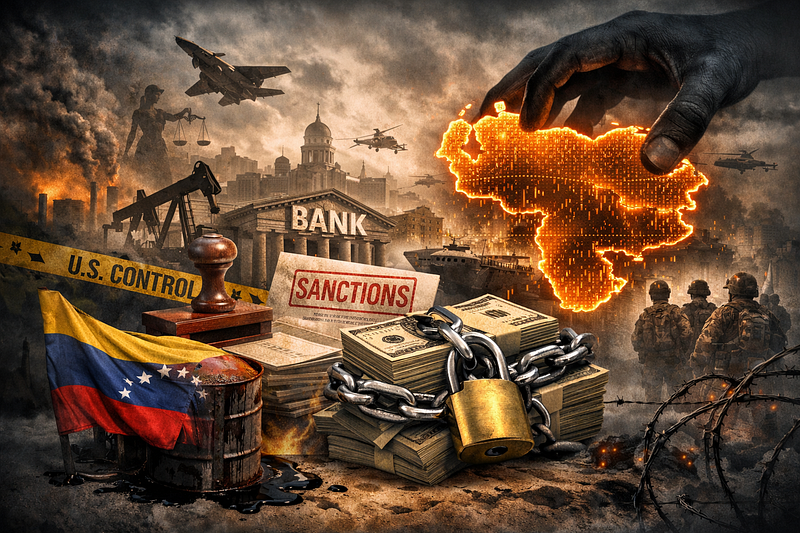
Call it sanctions if you want.
What matters is who decides where the value goes.
A tanker that never sails
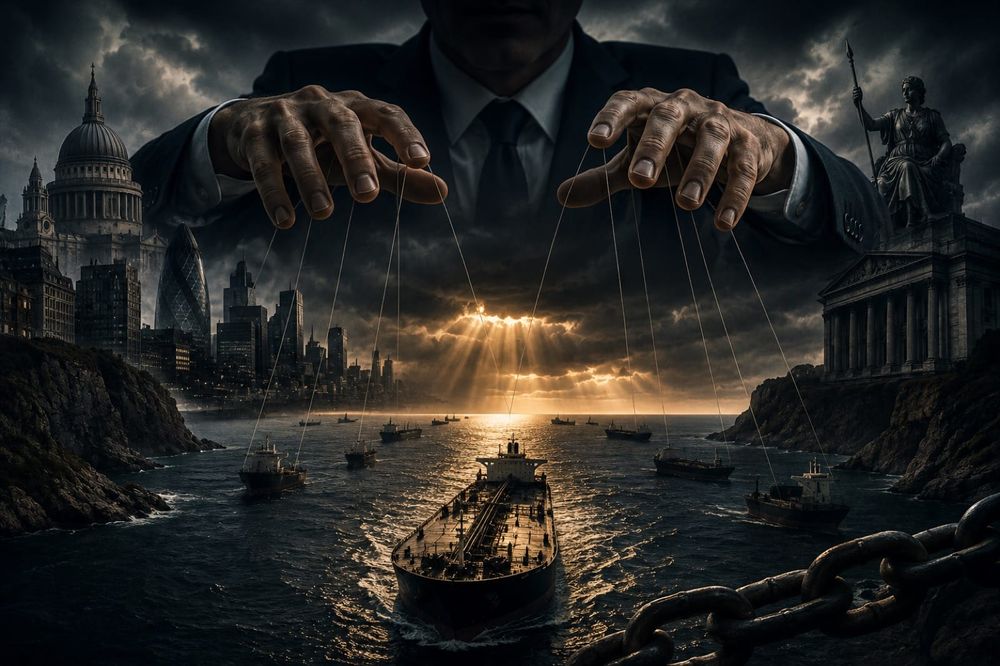
In the port of José, an oil tanker waits. Or rather, it doesn’t.
The vessel is fueled. The crew is present. The crude is loaded. The destination has buyers. On paper, everything is ready. But the ship does not leave.
Not because of weather.
Not because of technical failure.
But because insurance was withdrawn.
No insurer will touch the voyage. Not because Venezuelan oil is unsellable, but because insuring it risks exclusion from the wider financial system. One signature, one policy, one violation of compliance, and an entire company becomes radioactive.
The tanker remains docked.
The oil remains trapped.
The revenue never arrives.
No soldier blocks the port.
No gun is raised.
If a product cannot move and payment cannot arrive, ownership ceases to be operational.
Sanctions as siege, without the word siege
Sanctions are often framed as nonviolent pressure. That framing is false.
They do not target governments. They target systems that keep societies functional. Banking, logistics, insurance, spare parts, credit. The invisible infrastructure that allows a modern state to exist.
Hospitals do not collapse because a president is corrupt.
They collapse because transactions are blocked.
Food shortages do not arise because ideology fails.
They arise because payment channels disappear.
What follows is always presented as evidence of internal dysfunction. The cause is quietly removed from the frame.
If you cut the oxygen and blame the breathing, the conclusion is predetermined.
When chaos becomes the justification
Once a society begins to fracture under this pressure, the next phase becomes available.
Instability is rebranded as a problem requiring intervention.
Poverty becomes proof of mismanagement.
Social breakdown becomes moral permission.
At that point, language shifts.
Not seizure, but asset protection.
Not theft, but temporary management.
Not domination, but stabilization.
The country is no longer treated as a sovereign entity, but as a failed operation in need of external oversight.
If someone else decides what happens to your assets, the debate about terminology is already over.
When drugs become the language of ownership
The charge is always familiar.
Not oil.
Not access.
Not control.
Drugs.
The accusation appears with mechanical precision when a state leader presides over resources that cannot be taken openly. It is not chosen because it is the strongest claim, but because it performs a specific function.
Once a leader is labeled a narcotics trafficker, sovereignty no longer functions as protection.
A head of state becomes a suspect.
A country becomes a case file.
Assets become evidence.
At that point, intervention no longer needs a mandate. It needs jurisdiction.
The case works before it is proven, because its purpose is not judgment but access.
If drugs were the standard, the list of targets would look very different.
The largest logistics networks facilitating narcotics trafficking would not operate under permanent military protection.
Airfields used for counter-narcotics operations would appear first in indictments.
Allied militias with documented involvement in drug flows would not receive weapons, training, or intelligence.
Entire wars would collapse under their own evidence.
Afghanistan would not be remembered as a failed state.
It would be remembered as the largest heroin production expansion in modern history, unfolding under full NATO presence.
Colombia would not be a strategic partner.
It would be an open file.
Mexico would not be a neighbor.
It would be a crime scene.
And institutions with decades of documented interaction with narcotics networks would not lecture others about criminality. They would be standing trial.
Drugs are not the crime being punished.
They are the label applied when punishment is required.
If drugs were the standard, enforcement would begin with power, not with those who lack it.
Where money stops being neutral
The most persistent illusion in modern geopolitics is that money is passive.
It is not.
Money is the quietest weapon in the system because it does not need to threaten. It only needs to refuse. And refusal, when institutionalized, produces outcomes that once required armies.
Venezuela was not economically isolated because it lacked resources. It was isolated because it lost access to the machinery that turns resources into value.
That machinery is not located in Caracas.
It never was.
Most countries do not hold their money where they use it.
International trade requires correspondent banking, a system in which local banks rely on globally connected institutions to clear transactions, settle accounts, and move funds across borders. These relationships are not rights. They are privileges.
Lose them, and money stops traveling.
Sanctions do not need to confiscate funds directly. They only need to make it unsafe for intermediary institutions to touch them. Once that happens, the result is indistinguishable from seizure.
Payments stall.
Credits expire.
Suppliers disengage.
No headline announces this moment.
It happens inside compliance departments.
No vote interrupts this.
Compliance as enforcement
Compliance sounds bureaucratic. That is its strength.
No intelligence officer calls a bank and gives an order. There is no threat, no ultimatum. There is only guidance, advisories, risk assessments, and the quiet implication that continuing business may expose the institution to penalties, audits, exclusion, or reputational damage.
Banks do not ask whether sanctions are fair.
They ask whether compliance is safer.
The rational choice is withdrawal.
And once withdrawal begins, it spreads.
One bank steps back.
Another follows.
Insurers reassess.
Shipping firms disengage.
Soon, the economy is not sanctioned by decree.
It is abandoned by consensus.
How silence is manufactured
Power no longer needs secrecy.
It needs normalization.
Venezuela was not erased from headlines.
It was flattened into background noise.
Sanctions are announced.
Markets adjust.
Experts comment.
Another crisis replaces the previous one.
Nothing dramatic happens.
Complexity becomes a shield.
The story is never told as a sequence of actions with consequences. It is told as a mesh of factors. Sanctions, but also mismanagement. External pressure, but also internal failure.
Each element may be accurate.
Together, they exhaust judgment.
Historical continuity: from empire to administration
Nothing here is unprecedented.
Iran was contained.
Iraq was dismantled.
Libya was collapsed.
Each iteration refined the method.
Less visibility.
More legality.
Fewer soldiers.
More contracts.
The objective remained unchanged.
The cost profile improved.
Gradual collapse replaced shock.
This is why it holds.
Why knowing no longer helps
Every element of the Venezuelan case is public.
The sanctions.
The indictments.
The compliance regimes.
The financial choke points.
Nothing is hidden.
And yet nothing changes.
In systems where outcomes no longer depend on belief, exposure no longer functions as resistance.
Truth documents.
It no longer arbitrates.
Final reflection
Strip away the legal language, the moral framing, and the procedural noise, and one fact remains untouched.
Control changed hands.
Calling it law does not change that.
Calling it order does not reverse it.
Calling it enforcement does not disguise it.
What Venezuela reveals is not only how power operates, but what truth is allowed to do once power no longer depends on it.
Knowing what happens no longer changes what happens.
This is what modern power looks like when it no longer needs persuasion.
Not chaotic.
Not dramatic.
Just decisive.
Venezuela is not a scandal.
It is a signal.
And signals are only sent when the sender is confident they will be absorbed.