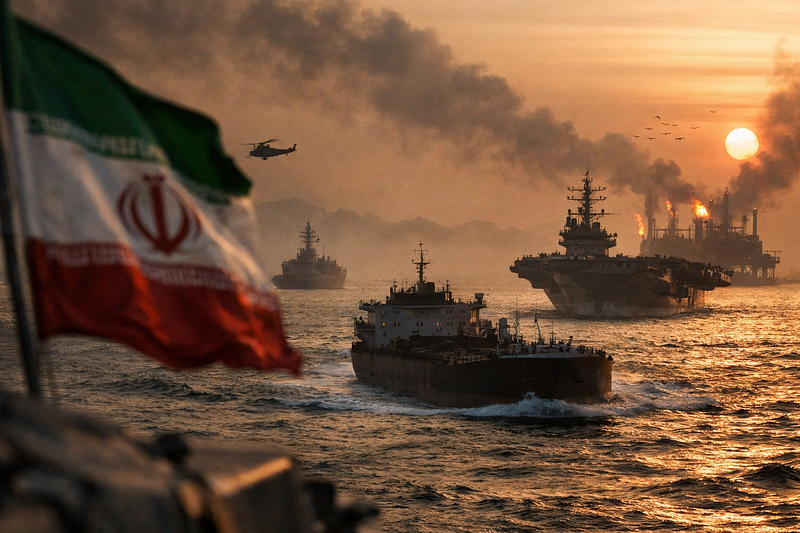
Trump’s five-day pause does not mean the pressure is over. It means Washington, Tehran, and everyone around Hormuz are recalculating the next phase.
The Pause That Pretends to Be Peace
There is always a moment in a conflict when the headlines become softer than the reality.
A deadline is extended. Markets calm. Oil falls. Commentators reach for the familiar vocabulary of diplomacy, prudence, and possible breakthrough. The tone changes first. The structure underneath rarely does.
That is where the confrontation between the United States and Iran stands now.
Trump has extended by five days the deadline he had imposed on Iran over the Strait of Hormuz, while postponing threatened U.S. strikes on Iranian power and energy infrastructure. Washington presents the pause as the result of “very good and productive conversations.” Tehran rejects that version, denies that negotiations are taking place, and says the American language is meant to lower energy prices and buy time.
The media will be tempted to call this de-escalation.
That is too generous.
The threatened strike has been delayed, not canceled. The military posture remains. The coercive logic remains. Hormuz remains unstable. The confrontation has not been resolved. It has only entered a different rhythm.
This is not de-escalation.
It is repositioning.
A delayed strike is not a change of direction. It is a recalculation of timing.
What Actually Changed
The easiest way to understand the moment is to strip away the theater and look at the sequence.
Trump issued a 48-hour ultimatum tied to reopening the Strait of Hormuz and threatened to strike Iranian power plants and other energy infrastructure. He has now extended that deadline by five days. He says conversations are underway and could lead to a “complete and total resolution.” Iran denies that account and insists Washington is the party under pressure.
That sequence matters because it changes the tempo, not the structure.
Washington did not abandon the threat. It kept it in reserve.
Tehran did not concede. It denied the premise.
So the core architecture of the confrontation is still intact. The United States still uses infrastructure threats to force movement. Iran still relies on endurance, denial, and retaliatory credibility to avoid appearing compelled. The pause exists inside that coercive framework, not outside it.
A pause under those conditions is not peace.
It is an interval inside pressure.
Why Five Days Matter
At first glance, five days looks trivial. In strategic terms, it is not.
Five days can be enough to stop immediate escalation, steady markets, move naval assets, reassess targets, warn allies, open indirect channels, test each side’s red lines, and prepare a different public story for whatever comes next. That is why the pause matters. Not because it solves anything, but because it creates room in a system under tension.
The evidence is visible already. Oil prices fell sharply after Trump’s announcement. Equity markets bounced. That does not mean the conflict is over. It means systems that were pricing immediate escalation suddenly received a short burst of oxygen.
A few days also matter because they allow all actors to do something politically essential.
They allow them to reposition without admitting retreat.
Washington can say it chose diplomacy.
Tehran can say Washington blinked.
Markets can pretend calm returned.
None of those narratives changes the underlying reality.
The deadline was not removed.
The danger was delayed.
A delay is not a solution. It is a decision to move later instead of now.
Why the US Framing Should Be Read Carefully
This is where propaganda enters, not always as direct falsehood, but as atmosphere.
The American presentation of such pauses almost always comes wrapped in the language of controlled maturity: productive talks, space for diplomacy, strategic restraint, time for peaceful resolution. But when the strike option remains live, and the coercive objective remains unchanged, that language should be treated with caution.
It may describe a real tactical pause.
It does not by itself prove a strategic shift.
If Washington says it created a diplomatic opening, it casts itself as rational and restrained. If Iran says there were no talks and that Trump backed down, it casts the same pause as evidence of American hesitation. Both narratives are trying to occupy the same terrain: control over the meaning of the pause.
That is why it is better to ask a simpler question than either side wants asked.
What changed materially?
Not much.
The strike option remains. Hormuz remains a lever. The crisis has not been closed. It has been reframed.
When both sides claim the pause proves their strength, the pause is not peace. It is positioning.
The International Pressure Behind the Pause
Trump did not make this move in a vacuum.
Russia publicly warned Washington against striking Iran’s Russia-built Bushehr nuclear plant and said any such attack could have “irreparable consequences.” China renewed its calls for diplomacy and openly blamed the United States and Israel for driving the conflict. India warned that the war was already straining its energy security. Even the UN’s language hardened, describing the conflict as a grave threat to international peace and security.
That does not prove Trump was personally “talked down” in some simple sense.
But it does show that the costs of immediate escalation were rising from multiple directions at once.
Military risk.
Energy risk.
Diplomatic risk.
Narrative risk.
That is what repositioning often looks like at the highest level. Not one leader losing nerve, but a converging field of pressures making immediate action more expensive than delayed action.
So the better reading is not that Trump suddenly became peaceful.
It is that the cost of acting immediately appears to have become too high.
Hormuz Is Still the Lever
The Strait of Hormuz remains the center of gravity because too much of the world economy still breathes through it.
That is what makes this confrontation bigger than a normal military exchange. Any threat, delay, or strike tied to Hormuz is not only regional. It is metabolic. It affects oil, shipping, insurance, inflation, expectations, and political stability far beyond the Gulf.
This is why the pause cannot be read as reassurance.
It is better read as recognition.
Recognition that direct attacks on Iranian energy infrastructure under these conditions could deepen rather than relieve the crisis. Recognition that every move around Hormuz now carries a global economic shadow. Recognition that a strike, once launched, may not remain bounded to the objective used to justify it.
Hormuz is still the lever.
That is why the pause matters.
And that is why it changes so little.
The Legal Problem No One Wants to Emphasize
There is another layer here that should not be softened.
Threatened strikes on Iranian energy infrastructure are not just strategic decisions. They raise serious questions under international humanitarian law.
States often try to frame power plants, energy nodes, and major industrial systems as legitimate targets by arguing that they support the war effort. But that legal argument does not end the issue. Energy infrastructure is rarely cleanly military in its effects. Large-scale strikes on power generation can cascade directly into civilian life, disrupting hospitals, water systems, transport, communications, and basic survival.
That means the real question is not simply whether such targets can be named as strategically relevant.
It is whether the foreseeable civilian impact would be lawful, proportionate, and justifiable.
This matters because the language of targeting often becomes dangerously abstract. Infrastructure is discussed as though it were a map symbol. In reality, those networks carry civilian life.
Not every target that can be hit is a target that can be justified.
That legal and moral exposure makes the American threat more than a military issue. It makes it a question of how far coercion is willing to go while still demanding to be described as order.
What Repositioning Means Here
Repositioning sounds vague until it is broken into parts.
Here, it means buying time. Washington gets a short interval in which it can avoid immediate escalation while preserving the strike option. Tehran gets a short interval in which it can avoid immediate impact while preserving the claim that it did not yield.
It means preserving pressure. The United States retains coercive leverage through military threat. Iran retains leverage through Hormuz, through regional spillover risk, and through the implied costs of any attack.
And it means managing narrative. Washington needs the delay to look like diplomatic seriousness. Tehran needs it to look like American hesitation. Neither side can afford to let the pause read as weakness.
That combination is what repositioning is.
Not retreat.
Not settlement.
A temporary redistribution of pressure before the next move.
Will America Attack Again After This “Reflection”?
This is the question under the entire moment, and the honest answer is yes, that risk remains very real.
Not because war is inevitable in some mystical sense, but because the strategic logic that produced the threat remains intact. The deadline extension did not resolve the underlying dispute. It did not remove the American objective. It did not reopen Hormuz in some stable way. It did not dissolve the coercive framework. It did not produce a verified breakthrough. The strike option was delayed, not renounced.
So what should be expected after repositioning?
The first plausible scenario is a renewed strike after the pause, especially if Washington decides the extension improved optics but changed nothing substantive.
The second is a longer cycle of controlled tension, with threats, deadlines, partial denials, market swings, and intermittent diplomatic theater recurring without resolution.
The third, less likely but still possible, is some kind of limited indirect arrangement that lowers immediate pressure without settling the larger conflict.
At this point, the first two appear more plausible than any real settlement, because the structure still favors pressure over trust and coercion over closure.
That does not mean an American attack is certain.
It means the pause should not be mistaken for a reversal.
The danger after a pause is not that conflict disappeared. It is that the next strike becomes easier to sell because the pause made the system look reasonable.
The Pattern Beneath the Moment
This is the part daily coverage almost never explains well enough.
The sequence now visible between the United States and Iran is patterned.
Threat.
Deadline.
Escalation risk.
Temporary pause.
Narrative contest.
Renewed pressure.
That is not random volatility. It is how controlled tension often works in modern geopolitics. Neither side wants immediate uncontrolled collapse. Neither side wants to appear weak. Neither side wants to surrender leverage. So the conflict moves in pressure waves.
This is why calling the present moment de-escalation is misleading.
De-escalation would require a meaningful reduction in coercive structure.
What we are seeing instead is a pause that helps every actor conserve leverage while assessing the next round.
Washington can say it chose restraint. Tehran can say it forced hesitation. Markets can briefly calm. But the mechanism underneath remains where it was.
Pressure is still the language.
Hormuz is still the lever.
Closing Reflection | A Pause Is Not a Peace
The most dangerous moments in modern conflict are not always the loudest ones.
Sometimes they are the moments that look calmer than they are. The ones where deadlines are extended, the language softens, and the public is invited to mistake delay for resolution.
That is what this is.
The United States has not changed its strategic posture. Iran has not surrendered its leverage. The Strait of Hormuz has not lost its centrality. The threat has not vanished. The pause has only changed the rhythm.
And rhythm matters.
Because once a strike is delayed rather than canceled, the system begins preparing the conditions under which it may return.
It looks like reflection.
It may be nothing more than calibration.
This is not de-escalation. It is a conflict deciding where pressure goes next.
Further Reading from The Manifest
This article is part of The Manifest, a continuous exploration of the systems behind global events.
For the wider structure behind the current US–Iran confrontation, continue here:
- Strait of Hormuz: The Chokepoint That Could Break the World Economy
- The Iran Escalation Is Bigger Than the Headlines
- Europe and the Strait of Hormuz: Drifting Into a War It Cannot Control
- The Manifest, Week 12, 2026: What This Week Revealed About Power
Follow The Manifest if you want to see the structure before it becomes visible.