The Numbers Moved First
The numbers changed before the language did.
At a petrol station in Europe, the board glowed in the thin morning light. The road was still damp. A delivery van rolled in, paused, then edged toward the pump as if hesitation itself might lower the price. No minister stood beneath the sign. No anchor explained the digits. No official voice was yet saying containment, stability, temporary pressure. There were only the numbers, climbing in public, and the quiet recognition on ordinary faces that something far away had already arrived.
That is how historical breaks enter a society. Not first as doctrine. Not first as memory. Not first as the solemn language of statesmen pretending they are still in command of the scale of events. They arrive through price boards, freight tables, insurance screens, delayed cargoes, revised forecasts, thinner margins. They arrive materially before they arrive politically. By the time governments begin naming the crisis, the crisis has already begun naming itself.
And the most unsettling part is this: the distance between normality and the previously unthinkable may now be far smaller than modern societies still want to believe. Not a season away. Not safely placed somewhere in the next quarter. Not even necessarily months. In a system this tightly wound, the shift can begin in days, and in some sectors in hours. A corridor tightens. Insurance hardens. Energy jumps. Freight reprices. Central banks recalculate. Governments start speaking in the language of reassurance precisely because the material world has already moved beyond reassurance.
A war is called regional. A shock is called volatility. A new cost is called temporary. And all the while the structure underneath daily life begins to shift.
The numbers changed before the language did.
That was the first truth of this moment. The second was harder, and far more important. The United States and Israel attacked Iran, and in doing so they did not merely trigger a military exchange. They struck into a world that was already short on slack, short on trust, short on cheap energy, short on patience, and dangerously accustomed to pretending that fragility had passed.
What followed was not an overreaction. It was transmission.
The truly unthinkable is no longer far away. In a brittle system, it can begin before the public has even found the language for it.
The Corridor Everyone Already Knew
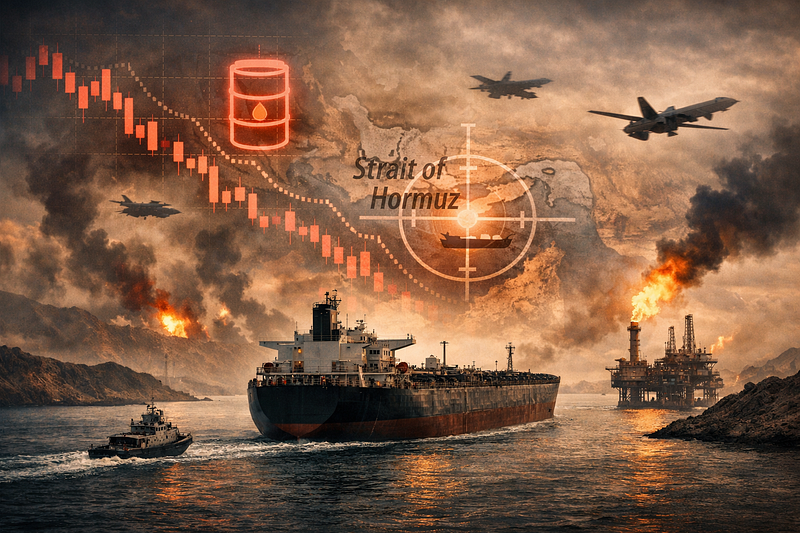
The Strait of Hormuz did not become important after the attack. It was important before it.
That single fact changes the moral contour of everything that followed. If a state acts in ignorance, the question is competence. If it acts while already knowing that one narrow passage carries a decisive share of the world’s energy bloodstream, then ignorance is no longer available as shelter. The question becomes judgment. Behind judgment stands responsibility.
Official language, of course, is designed to soften precisely this point. It rises above material life and begins speaking in phrases like deterrence, strategic necessity, balance, measured response. Such words are useful because they remove the tanker route from the strike, the refinery from the speech, the household bill from the decision, the supermarket shelf from the briefing. They create altitude where there should be friction. They let action appear abstract at the exact moment its consequences are becoming painfully concrete.
But there was never anything abstract about the corridor.
A tanker captain thinks in naval cover, insurer approval, route viability, and whether the sea lane will still be insurable by dawn. A refinery manager thinks in feedstock, replacement flows, storage pressure, missed timing, cost. A commodities desk does not wait for ideology. It watches exposure reprice itself in real time. A family does not need to know the geometry of maritime choke points to feel that a war has found the kitchen table.
This is the true geography of modern conflict. It does not end where the smoke rises. It travels.
They did not strike beside the artery. They struck while knowing the artery was there.
And once that is admitted, the event changes shape. It is no longer merely an eruption in a volatile region. It becomes evidence of what the age is willing to risk in full view of what the age depends on.
The point was never ignorance. The point was willingness.
The Decision to Proceed Anyway
This is the threshold where weaker writing loses its nerve. It describes the damage, but not the choice. It inventories the consequences, but not the moment those consequences were made foreseeable. It speaks as if the world simply drifted from tension into crisis, as if events unfolded by weather, gravity, or tragic inevitability.
They did not.
The U.S.-Israeli attack on Iran did not occur in a universe without alternatives. Diplomacy had not vanished. Delay had not become impossible. Pressure without direct escalation remained available. De-escalation remained available. Containment remained available. Restraint remained available. None of these were fantasies. None required innocence. All required decision.
That is why the true point without return came before the first market spike, before the first retaliatory exchange, before the first panel discussion about what this might mean for oil, inflation, or global stability.
The point without return was the prior decision to proceed anyway. To proceed despite the corridor. To proceed despite the known sensitivity of energy markets. To proceed despite the obvious inflationary danger. To proceed despite the frailty already visible in public endurance, industrial confidence, fiscal room, and political trust.
The danger was not discovered afterward. It was accepted beforehand.
That sentence must remain intact, because history’s favorite trick is to blur the line between hazard and choice. Once the consequences arrive, they are narrated as turbulence, uncertainty, spillover, repricing. Yet there is a difference between a storm and a decision. A storm belongs to nature. A decision belongs to people, to institutions, to governments, to names.
A risk becomes policy when leaders proceed after the warning, not before it.
That is the line that makes this chapter more than analysis. It is what turns the article into an account of responsibility.
How War Enters Ordinary Life
People imagine disorder arriving with sirens.
Usually it arrives with invoices.
A shipping premium rises. Fuel follows. Fertiliser follows after that. Then transport, food, manufacturing, retail, investment, household confidence. The public rarely sees the whole chain at once. It encounters the crisis in fragments. A more expensive tank. A delayed delivery. A cancelled purchase. A business that stops hiring. A government that postpones relief. A central bank that begins speaking more stiffly than it did a month earlier. A salary that feels smaller without having changed.
That is how geopolitical force becomes domestic pressure. Not all at once. Not theatrically. Not with a single clarifying catastrophe that forces the entire public to admit what has happened. It arrives by repetition. By accumulation. By the slow conversion of strategic violence into ordinary cost.
Empire is almost never paid for in the moment of declaration. It is paid later, in pieces, by those who did not choose it.
A truck driver filling up before dawn. A grower recalculating input costs. A warehouse manager revising forecasts. A family leaving something on the shelf. A city postponing repair, hiring, relief. Another month in which wages fail to catch the world in front of them.
War becomes real to the public when it enters the price of ordinary life.
That is the most democratic truth in the article, and the one official language works hardest to keep at a distance. Strategy is discussed upward. Cost is lived downward. Decision is concentrated at the top. Consequence diffuses outward, then downward, until millions of private adjustments have paid for what was sold as necessity.
The bomb falls in one place. The consequence begins traveling immediately.
The Return of Stagflation
For a brief and fragile moment, much of the governing class had convinced itself that the worst phase of inflation belonged to the immediate past. Price pressure was supposed to cool. Rate pressure was supposed to ease. The system, though bruised, was supposed to breathe again.
That confidence rested on a quiet assumption. That energy would remain calm enough for the fiction of recovery to hold.
The attack on Iran shattered that assumption.
With that fracture came the return of an older word, a word that belongs to harder decades and thinner illusions.
Stagflation.
Not merely inflation. Not merely stagnation. Both at once.
That is what makes this kind of historical moment so punishing. Prices rise because energy, transport, logistics, insurance, and industrial inputs all tighten together. Growth weakens because households retreat, industry hesitates, investment becomes harder to justify, and political systems begin operating under conditions of shrinking room. Every lever available to policymakers seems to worsen the pressure somewhere else.
Cut too early, and inflation flares harder. Hold too long, and weak economies constrict further. Promise calm, and markets punish the promise. Delay relief, and societies punish the delay.
The real threat was never inflation alone. It was inflation returning while growth failed.
That is when a crisis stops feeling cyclical and starts feeling civilizational. Not because civilization ends, but because the hidden assumptions beneath ordinary planning begin to corrode together. Stable fuel. Predictable borrowing costs. Reliable trade. Measurable exposure. These are the invisible luxuries of a system that still believes tomorrow will resemble today closely enough to be managed.
When that resemblance thins, fear changes quality.
It becomes administrative.
A system becomes dangerous when its pressures rise faster than its vocabulary can honestly contain.
The Crisis After the Crisis
One of the oldest political illusions is that visible de-escalation ends material disruption.
It does not.
A war may cool before its effects do. A ceasefire may come long before trust, routes, premiums, habits, and planning recover. An insurer does not forget risk because a statement has been issued. A shipper does not erase cost because ministers speak of stabilization. A manufacturer that has seen one vital corridor turn unstable begins to think differently long after the front page has moved on.
That is why duration is often more consequential than drama.
A single day of panic can be absorbed. A single week of violent pricing can still be called an overreaction. Even a brutal month can be domesticated into the category of interruption. But a longer disturbance rewires behavior. Consumers spend differently. Governments borrow differently. Investors harden. Companies shorten their horizon. Banks become less forgiving. Populations become less patient.
This is where rupture becomes condition. Not a moment, but a climate. Not a shock, but a mode of living.
The war recedes from the headline. The system does not return.
Trade stays more nervous. Energy stays more political. Insurance stays harder. Planning stays shorter. Trust stays thinner. Public tolerance becomes a depleting resource.
The war may end before the disruption does.
The headlines may fade before the costs do.
That is how history often works. The visible event is brief enough to narrate. The altered condition is long enough to govern a decade.
The Administration of Failure
For years the word unthinkable sounded melodramatic.
Now it sounds bureaucratic.
That is the turn.
The real unthinkable is not that everything collapses in a night. That belongs to fantasy, to cinema, to the adolescent appetite for spectacle. The real unthinkable is slower, cleaner, more managerial, and therefore more difficult to resist.
It is the possibility that the system fails without ever declaring failure.
Energy remains less secure. Trade remains more expensive. Inflation proves harder to extinguish. Rates remain higher than societies can comfortably bear. Industry weakens in the places most dependent on cheap fuel and predictable movement. Governments lose room to cushion. Trust continues thinning, thread by thread, until entire populations begin to live in a lower register of expectation without ever being asked whether they consented to it.
Nothing breaks loudly enough to force truth.
So the deterioration is managed. Translated. Softened. Renamed.
This is the genius of systems in decline. They do not always conceal reality outright. Often they reclassify it. Adjustment. Transition. Resilience. Temporary stress. Strategic patience. Each term performs the same political labor. Each one delays recognition. Each one asks the public not to call a pattern by its proper name.
The unthinkable is no longer that the system could fail. It is that failure can be administered and renamed while it is happening.
That is darker than collapse.
Collapse at least has the decency to announce itself.
Managed decline arrives with polished language, official concern, and revised guidance.
Failure no longer needs to be hidden if it can be narrated as adaptation.
This Chapter in the Larger Manifest
This chapter begins with Iran, but it does not end there.
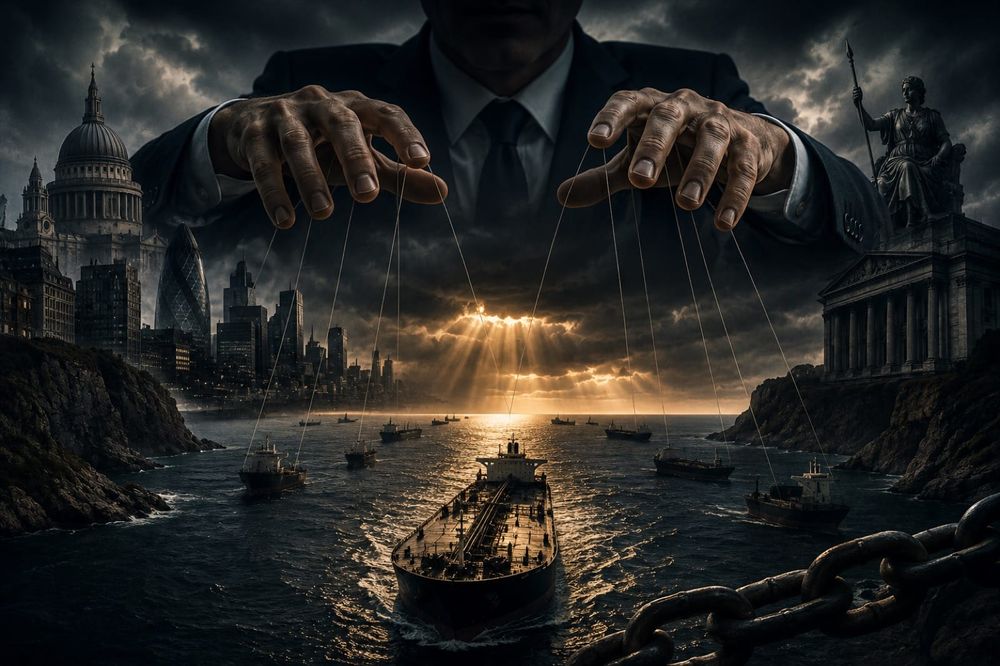
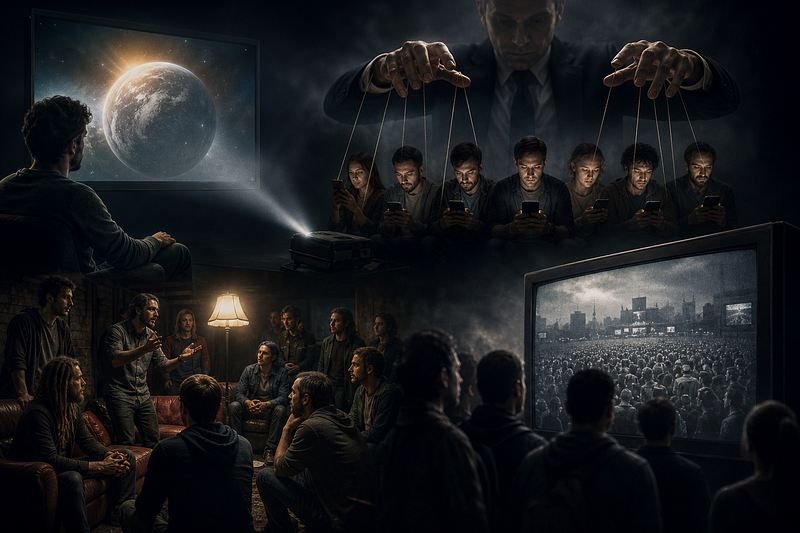
It opens into the larger architecture that runs through The Manifest: power presented as protection, dependence sold as order, costs pushed downward while responsibility dissolves upward, language functioning not only as explanation but as cover.
One chapter enters through war. Another through aid. Another through NATO, sanctions, reconstruction, institutional legitimacy, financial engineering, intelligence, censorship, historical memory.
The doorway changes.
The mechanism does not.
Here, the doorway is energy. A visible strike. A known corridor. A predictable transmission. A widening gap between those who decide and those who absorb. What begins as military action is completed as economic discipline. What begins as strategy above returns as pressure below.
This chapter begins with Iran, but it belongs to the larger story of how modern systems export consequence and rename the result.
That is why this piece should not be read as a standalone reaction to current events. It is another lens inside the same structure. Another view of how order is maintained by dispersing cost, diluting authorship, and asking the public to endure what it was never allowed to decide.
Closing Reflection
What began with the U.S.-Israeli attack on Iran did not remain there.
It moved through tanker routes, insurance screens, commodity desks, ministries, factory floors, supermarket aisles, kitchen tables.
It moved first as price, then as pressure, then as policy language trying to arrive after the fact and soften what had already become materially true.
It moved through the old machinery by which decisions are concentrated and consequences are dispersed.
The darkest part is not that this could happen.
The darkest part is that it was foreseeable enough to proceed anyway.
That is what gives the moment its weight. Not merely violence. Not merely escalation. Not merely another eruption in a region long trained to absorb the world’s projected instability. Something colder than that.
A choice made in full view of a fragile world.
A strike that revealed how little margin remained beneath the language of control.
A historical opening through which the future began to look narrower, harsher, and more expensive before most people had even found the words for what they were seeing.
This was not only an attack. It was the moment the system was forced to reveal how much of its stability had always depended on denial.
And once that is seen, the event can no longer be filed away as another distant crisis. It becomes a threshold. The kind history later describes too softly, because it has forgotten the texture of the first days and the quiet public knowledge that reality had shifted before the authorities admitted it.
Remember always where it truly began, and who set it in motion.
Read next in
The Manifest
To follow this rupture deeper through the larger architecture, continue with these chapters:
The Growing Condemnation of the U.S.-Israeli Attack on Iran
March 2026: The Early Stage of WW3