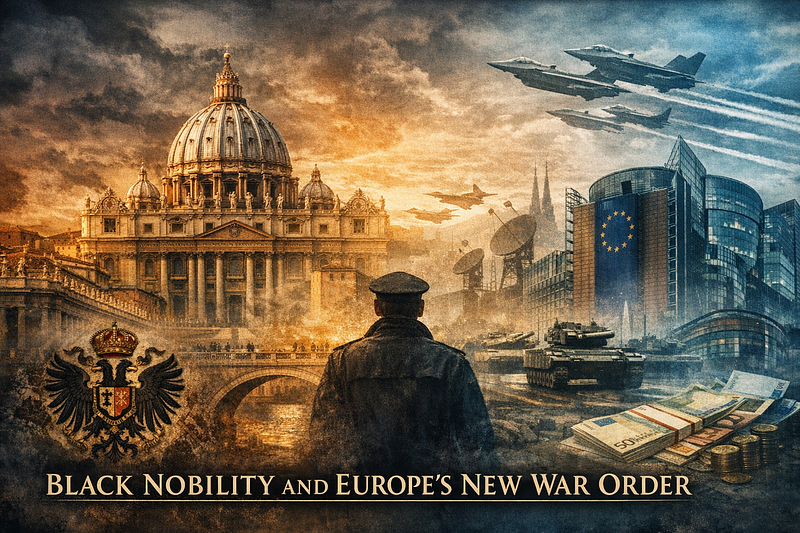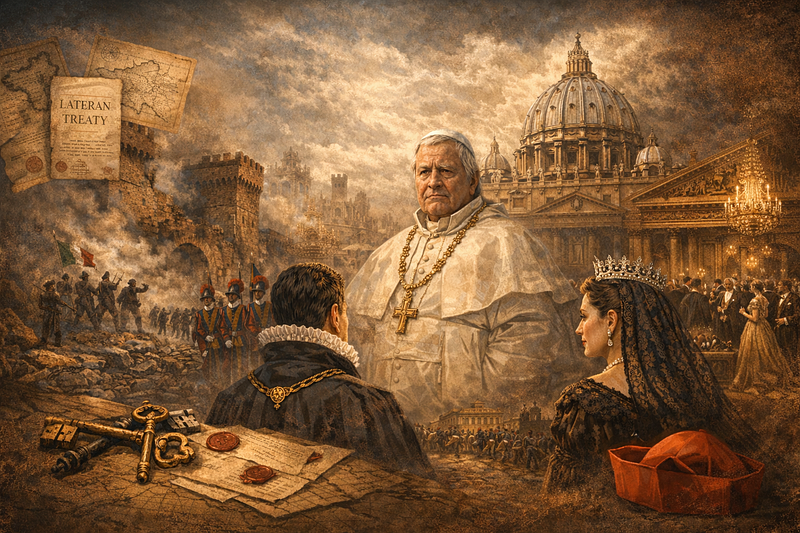
How a lineage of elite houses shaped the continent from the Renaissance to the present quietly, steadily, and without ever needing a throne.
Rome at Dawn: Where Time Learns to Whisper
Rome wakes slowly.
Not out of laziness, but out of confidence, the kind a city gains only after surviving every definition of power humanity has attempted.
In the blue hour before sunrise, the streets near Piazza Navona feel suspended between centuries. Light rests on the stone the way memory rests on a scar. Quietly. Without apology.
A caretaker sweeps the courtyard of a palazzo tourists photograph without understanding. His broom moves across marble steps worn smooth by five hundred years of footsteps. Diplomats, cardinals, astronomers, archivists, lovers. And the occasional monarch who believed, incorrectly, that he ruled the world.
Inside, the air thickens.
Hinges sigh with a memory older than the states that surround them. Portraits observe with expressions unchanged by revolutions. Dust drifts in a shaft of sun like unspoken secrets testing the air.
The modern visitor sees architecture.
But these buildings are not architecture. They are instruments.
“Power does not survive by ruling.
It survives by remembering.”
Armies rust.
Crowns fracture.
But rooms endure.
And so do the families who learned to endure with them.
Orsini.
Colonna.
Borghese.
Aldobrandini.
Farnese.
Chigi.
Medici.
They no longer sit on thrones.
They do not need to.
Throne rooms crack.
Crowns migrate.
But rooms, rooms are the bloodstream of continuity.
The Black Nobility understood a lesson kings never learned.
“The aim of power is not dominion.
The aim of power is duration.”
A Library Older Than Nations
In one of these palazzi, a young heir walks through a corridor lined with frescoes older than his country’s identity. In his hand is a brass key, cold even in warmth. Tarnished stem, jagged teeth, purpose known only to a few.
Behind a tapestry depicting the Council of Trent waits a hidden lock.
The key turns.
A narrow door opens.
Cool air.
Leather bindings cracked with age.
Handwritten ledgers in ink that predates modern Europe.
Diplomatic letters older than the United States.
Maps drawn in pigments once forbidden by popes whose names history barely remembers.
At a heavy table sits the ghost of his grandfather.
The old man believed that some rooms were not meant to be visited.
They were meant to instruct.
The grandson does not yet understand what he inherits.
Not wealth.
Not titles.
Not estates scattered across regions that forgot their architects.
He inherits continuity.
The obligation to remember in a world that keeps forgetting itself.
Nothing in this room is decorative.
Everything is strategic.
“Memory is the only currency that survives the fall of empires.”
The Black Nobility did not begin with dominance.
They began with stewardship.
Venice: Where Power Learned to Wear a Mask
Before Rome became their anchor, Venice was their crucible.
Venice, the republic that perfected the art of looking transparent while negotiating in shadows. A city where ballots performed democracy while decisions were made long before they were cast.
Bells rang.
Crowds cheered.
Masks hid everyone and revealed everything.
Power did not shout.
Power arranged.
A marriage could secure a century of peace.
A whisper could redirect a trade route.
A gesture at a masquerade could realign loyalties more effectively than a treaty.
In Venice, the young families of Europe learned the foundation of continuity.
“The world remembers events.
Continuity remembers the rooms where events were prepared.”
They were not learning to rule.
They were learning to survive rulers.
Rome: When Continuity Became Global
Rome offered what no kingdom could.
A global institution with no dependency on geography.
The Church projected power not through land but through meaning.
Through doctrine.
Through archives.
Through time.
In the Curia, whispers shaped continents.
In the Vatican Library, knowledge became leverage.
In the Apostolic Palace, a signature could tilt half of Europe.
The families fused with the Church not as rulers, but as a nervous system.
Their sons became cardinals and jurists.
Their daughters extended Rome’s reach through dynastic diplomacy.
Their estates funded missions, academies and infrastructure that stabilised societies long after crowns fell.
They entered the bloodstream of an institution designed to outlive empires.
“Institutions do not grow through power.
They grow through the hands that maintain them.”
The Reformation: When Continuity Shifted Shape
Europe fractured.
Altars shattered.
Doctrines warred.
Borders ignited.
Yet the Black Nobility moved through the chaos with the composure of entities accustomed to surviving centuries of turbulence.
Where Catholic influence weakened, they strengthened its intellectual skeleton — schools, missions, manuscript repositories, legal faculties.
Where Protestantism rose, they entered secular roles — universities, civil services, cultural institutions.
Continuity did not break.
It adapted.
The Reformation was weather.
They did not fight the storm.
They learned its direction.
“Ideas divide.
Memory navigates the division.”
The Age of Monarchies: Kings on Stage, Families in the Walls
Kings performed.
Coronations.
Armies.
Rituals and ceremonies.
But performance is not endurance.
Real influence lived in unglamorous places.
Midnight letters that softened a treaty.
Marriages that prevented unrecorded wars.
Archives where meaning was quietly renegotiated.
Salons where maps were drawn long before borders changed colour.
A king could start a war.
A cardinal and a nobleman could prevent one.
“Power that stands in the light burns.
Power that hides in the walls endures.”
Their theatre was not the balcony.
It was the corridor.
The Enlightenment: When Thought Became the New Frontier
The Enlightenment arrived not as rebellion, but as a tremor.
A quiet earthquake of ideas.
Philosophers questioned dogma.
Scientists described laws older than scripture.
Salons became laboratories where Europe reimagined itself.
Monarchies stiffened.
Churches recalibrated.
Empires strained.
The families adapted with the ease of entities that had already survived greater transitions.
Power does not rely on certainty.
It survives through adaptation.
They funded academies, sponsored scholars, restored palazzi into salons where diplomats debated beneath frescoes older than the nation-state.
They learned the language of progress — inquiry, reason, experiment — not to appear enlightened, but to ensure continuity survived its latest mutation.
“When the world changes its mind, the families who listen survive.
The families who resist evaporate.”
Revolution, Modernity, and the Century That Broke Europe
The French Revolution shattered symbols but lacked the expertise to rebuild structures.
The families returned not as nobles but as technicians.
They stabilised ministries, restored archives, interpreted legal codes.
Modernity accelerated.
Factories swallowed fields.
Railways cut through identities.
Nations were invented and hardened.
Many aristocracies clung to symbols.
The Black Nobility strengthened function.
“Aristocracy dies when it clings to appearance.
Continuity survives when it strengthens function.”
World War I cracked Europe open.
World War II tried to burn its memory.
The families survived both by protecting the infrastructure of continuity — archives, diplomacy, cultural memory, clerical networks, intellectual scaffolding.
Their work was not heroic.
It was structural.
“Survival is not the absence of danger.
It is the presence of structure.”
Postwar Europe and the Birth of Institutions
1945 gave Europe a paradox.
It needed to reinvent itself with institutions that had no memory of how Europe once functioned.
The families stepped in as stewards.
They provided diplomatic memory, cultural ballast, legal continuity.
They restored cathedrals, archives, universities and heritage sites.
Postwar Europe was built on new ideas.
Its stability rested on ancient hands.
“Institutions cannot reinvent themselves without memory.
And memory must be held by someone.”
The European Union emerged.
Observers saw novelty.
The families saw restoration.
Courts above borders.
Commissions above governments.
Structures above cycles.
“Nations argue.
Institutions endure.”
The Twenty-First Century: A World Losing Its Shape
The new century arrived fast.
Too fast.
Acceleration replaced stability.
Identity splintered.
Truth became negotiable.
Europe moved from crisis to erosion.
The families adapted once more.
They defended universities.
Reinforced archives.
Stabilised Vatican diplomacy.
Protected culture from austerity and revision.
They intervened where the absence of continuity posed real danger —
a collapsing museum,
a threatened archive,
a disappearing academic programme.
“Culture is not decoration.
It is orientation.”
Orientation is what Europe was losing fastest.
The Human Element: Heirs Who Never Chose Their Burden
Inside the mythology of the Black Nobility lives something profoundly human.
Heirs who cannot afford to heat their palazzi.
Children of archivists who grow up surrounded by centuries they barely comprehend.
Scholars who inherit memory they never asked for.
Reluctant custodians who cannot walk away without betraying more than themselves.
One heir said it plainly:
“I did not choose this role.
But if I let the archive fall, a part of Europe falls with it.”
This is not aristocracy.
This is obligation.
And obligation, unlike power, cannot be voted out.
Closing Reflection | The Architecture Beneath the Architecture
Walk through Rome at dusk and you begin to notice what noise conceals.
Courtyards where footsteps soften into memory.
Libraries where dust settles on manuscripts older than nations.
Archives whose silence has outlived empires.
Cloisters where history breathes more slowly than modern time allows.
Europe appears fragmented.
Its politics unstable.
Its identity contested.
Its future uncertain.
But beneath the surface, another pattern holds.
Not ideology.
Not dominance.
Not belief.
A discipline.
A craft.
A long apprenticeship in survival.
The Black Nobility did not outlast kings because they ruled everything.
They outlasted them because they understood what power forgets when it becomes visible.
Power does not survive by shouting.
It survives by structuring the silence.
Empires collapsed.
Nations rose.
Ideologies burned and returned wearing new colours.
Systems failed and reappeared under new names.
Continuity remained.
Not as command, but as scaffolding.
Not as rule, but as arrangement.
Not above the state, but beneath it.
Europe never belonged to those who announced their victories.
It belonged to those who preserved what endured after the noise faded.
Power does not end when it loses its throne.
It reorganizes what comes after.
You will find no shortage of content about the Black Nobility online. Most of it speculates. Some of it sensationalizes. The Manifest Archive documents.
The Manifest Archive publishes two versions of each analysis. This is the overview. The full version, including the complete ownership layer (how Black Nobility capital flows through BlackRock, Vanguard, and State Street into every major asset class simultaneously), the institutional reproduction mechanism, and the revolving door documentation, is available on Substack. Free to read.
themanifestarchive.substack.com/p/the-black-nobility-europes-families