The Night Sound Became a Weapon
The night Public Enemy took the stage in 1989, the air itself turned electric.
New York’s summer heat clung to every face in the crowd; bass rolled like thunder through concrete.
When Chuck D leaned into the microphone and shouted “Fight the Power!”, thousands of fists rose at once.
It wasn’t choreography. It was instinct — a pulse shared by strangers who suddenly remembered what unity felt like.
The speakers cracked, the ground shook, and for a few brief minutes the world was perfectly aligned: truth had rhythm again.
The stage lights cut through the smoke like flares on a battlefield.
No one there thought of sales, or charts, or algorithms.
They thought of survival, of dignity, of the power that could still live in a beat.
“Rap is CNN for Black America.”
Chuck D said that once, and the crowd that night understood.
Each verse was an article, each rhyme a headline the networks ignored.
They didn’t need permission to be heard. They needed volume.
From the wings, Flavor Flav kept time with a giant clock hanging from his neck — a reminder that protest has a schedule, and it’s always late.
Every sound system in the city was tuned to the same truth: music could still expose what power tried to hide.
That night wasn’t a concert. It was an editorial in rhythm and sweat.
Across the decades that followed, the echo of that moment stretched backward and forward at once — to Bob Dylan’s guitar in Greenwich Village, to John Lennon’s piano in a white room, to Marvin Gaye’s falsetto breaking over the word “brother.”
Each had once asked the same question in different tongues: Can sound change history?
For a while, it could.
A song could end a war, move a border, or unmask a lie.
Records didn’t just spin; they revolved like planets around a moral sun.
People gathered not for escape, but for alignment.
Then something shifted.
The studios grew quieter even as the speakers got louder.
Rebellion, once raw and unpolished, was mastered, compressed, and sold in high fidelity.
Every anthem became a product; every pulse, a subscription.
Somewhere between the last riot and the first algorithm, the hum of protest faded into the background noise of convenience.
The rebellion hadn’t died. It had been automated.
And as the world learned to stream instead of scream, the age of protest became a playlist.
They didn’t ban the protest. They just changed the frequency.
This story isn’t nostalgia for old guitars and worn vinyl.
It’s an autopsy of courage — the anatomy of a silence so engineered that it feels natural.
To understand how we arrived here, we have to rewind to the moments when music still believed it could speak truth.
When Dylan’s harmonica sounded like confession, when Lennon’s piano felt like prayer, when Simone’s rage made the air itself flinch.
The past didn’t simply sound better.
It dared more.
And in that daring lived the last honest dialogue between art and authority.
The Era of Faith — When Songs Still Believed
Long before the word activism became branding, songs were scripture for the restless.
They didn’t aim for playlists or profit — they aimed for truth, and sometimes for forgiveness.
The guitar was a weapon that didn’t need ammunition.
It only needed belief.
Bob Dylan and the Age of Witness
When Bob Dylan sang “The times they are a-changin’,” he wasn’t predicting a trend — he was giving history its cue.
The sound was raw, the phrasing imperfect, the words more sermon than melody.
In smoke-filled coffeehouses of the early sixties, his voice felt like gravel rubbing against conscience.
He didn’t flatter his audience; he warned them.
“Come senators, congressmen, please heed the call.”
“Don’t stand in the doorway, don’t block up the hall.”
The song moved through the decade like a weather front.
Civil rights marches took it as an anthem, Vietnam protesters as a hymn.
Dylan became both prophet and witness — not because he had answers, but because he dared to name the storm.
His songs were not slogans; they were coordinates.
They showed where America’s soul was buried.
And yet, even Dylan knew that words alone couldn’t save a generation.
They could only make silence impossible.
John Lennon and the Fragile Dream
If Dylan mapped the storm, John Lennon tried to calm it.
He sat in a white room, barefoot, surrounded by peace signs that looked less like decoration than desperation.
When he recorded “Imagine,” he didn’t sing as a Beatle — he sang as a man trying to rebuild belief from rubble.
The piano line was simple, almost childlike, as if truth needed no ornament.
Its simplicity was its weapon.
Every line asked the listener to erase something — heaven, hell, borders, possessions — until nothing was left but shared existence.
It sounded naïve to cynics and revolutionary to believers.
It still does.
“You may say I’m a dreamer, but I’m not the only one.”
Lennon’s dream was fragile precisely because it was honest.
He didn’t hide behind irony or intellectual armor.
He risked sincerity — the rarest form of protest.
And for that, the world both adored and feared him.
When he was killed outside the Dakota building in 1980, it wasn’t just a murder.
It was the assassination of a possibility: that a song could still make peace feel personal.
Nina Simone and the Power of Anger
If Lennon’s revolution came in whispers, Nina Simone’s came in fire.
She walked onstage with the presence of a trial.
Her piano was a judge, her voice a verdict.
When she performed “Mississippi Goddam” in 1964, the audience didn’t know whether to applaud or repent.
The song wasn’t polite — it was deliberate blasphemy against a nation that mistook patience for progress.
Simone had seen churches bombed and friends murdered.
She no longer believed in patience.
“Alabama’s gotten me so upset, Tennessee made me lose my rest.”
Every syllable burned through the illusion of gradual change.
It wasn’t a protest song; it was an indictment sung in perfect pitch.
The industry tried to silence her, but the silence she exposed was louder.
She became the conscience of an era that wanted rhythm without responsibility.
Her rage wasn’t chaos — it was clarity.
And in her clarity, you could hear the entire history of a people compressed into one octave.
Marvin Gaye and the Prayer for Mercy
Where Simone confronted, Marvin Gaye mourned.
When “What’s Going On” appeared in 1971, it felt less like a release than a revelation.
Soft, smooth, almost tender — yet every note trembled with grief.
The Vietnam War had turned sons into soldiers and cities into wounds.
Gaye sang from the wound’s center.
He didn’t shout, didn’t accuse.
He pleaded.
He made sorrow sound seductive enough to enter every living room in America.
“Father, father, we don’t need to escalate.”
“War is not the answer, for only love can conquer hate.”
The beauty of the record was its disguise.
Motown executives tried to block it, calling it uncommercial.
They didn’t understand that the smoothness was camouflage — the silk around a knife.
By the time they realized, the knife had already found its mark.
“What’s Going On” proved that protest didn’t have to scream.
It could ache.
It could weep.
And sometimes, that hurt louder than any chant.
Bob Marley and the Gospel of Liberation
While Gaye prayed for mercy, Bob Marley called for emancipation.
His music carried the cadence of scripture and the logic of resistance.
In Jamaica’s humid nights, “Get Up, Stand Up” wasn’t metaphor.
It was survival.
Marley’s genius was to turn politics into faith.
He sang of Jah and Babylon, of chains and freedom, until theology became rebellion.
To him, rhythm was not entertainment — it was resurrection.
“Emancipate yourselves from mental slavery.”
“None but ourselves can free our minds.”
The message crossed oceans because the condition it named was universal.
Every generation has its Babylon, and Marley knew it.
His concerts became pilgrimages where people didn’t just listen — they remembered they were alive.
He stood at the intersection of religion, politics, and sound, and made all three bow to love.
By the time cancer took him in 1981, he had done something no government could: unite humanity in rhythm.
For twenty years, music wasn’t a product — it was a practice of truth.
Dylan, Lennon, Simone, Gaye, Marley: five prophets of the same gospel — that the human voice, once amplified by courage, could alter the moral temperature of the planet.
They didn’t sing for streams or trends.
They sang to remind the world it still had a conscience.
They believed that honesty, set to rhythm, could change history.
And for a while, it did.
But belief is a fragile instrument.
It requires tuning, and attention, and faith.
As the seventies gave way to the eighties, the tuning began to slip.
The needle drifted from conscience to commerce, from protest to performance.
Sound still moved the masses — but not toward freedom.
The rebellion was still onstage.
It had just changed sponsors.
The Electric Rebellion — When Anger Found a Beat
By the time the seventies dimmed into neon, protest had changed its clothes.
The folk guitars grew dusty; the anthems of unity were now commercials for nostalgia.
The crowd still gathered, but the message had shifted — from we shall overcome to we already did.
The revolution had been televised, branded, and exported.
And yet, beneath the optimism of the eighties, something darker began to hum.
The world was split again — not by color or class this time, but by screens, walls, and the cold logic of nuclear arithmetic.
Artists who still cared about conscience had to find new languages to speak in.
Some chose quiet.
Some chose noise.
The Quiet Resistance — When Protest Turned to Reflection
When Sting released “Russians” in 1985, protest no longer sounded like a march.
It sounded like a whisper through static.
He sat at a piano, quoting Prokofiev’s Lieutenant Kijé Suite, and sang of mutual destruction with a tenderness that terrified generals.
No slogans, no fists — just a plea disguised as a lullaby:
“We share the same biology, regardless of ideology.”
It was the most dangerous kind of protest — the kind that sounded like compassion.
Sting didn’t point at enemies; he dissolved the idea of them.
In the middle of the Cold War, that was rebellion enough.
His voice hovered between guilt and grace, as if warning the world that empathy itself had become subversive.
He wasn’t alone.
Don Henley, too, wrote like a witness wandering through capitalism’s afterglow.
His “New York Minute” wasn’t a protest in name, but it mourned the same decay that Lennon once feared.
A man collapses, a crowd passes, a city forgets — all in the time it takes a traffic light to change.
“In a New York minute, everything can change.”
Henley’s America wasn’t burning; it was anesthetized.
He sang about moral speed — how progress had outpaced conscience.
Where Dylan’s protest lived in the street, Henley’s lived in the elevator.
He saw that the war was no longer fought in jungles or parliaments, but in hearts dulled by comfort.
Together, Sting and Henley captured something prophetic:
that rebellion was no longer loud, it was lonely.
The revolution had moved indoors — to studios, to apartments, to quiet rooms where people still cared but no longer believed it mattered.
They were the philosophers of fatigue — proof that silence, too, could be a protest.
But silence has limits.
And just as introspection began to fade into apathy, a new generation took the stage with no patience for quiet revolutions.
The Return of Noise
Enter The Clash.
They didn’t ask for permission or forgiveness.
Their guitars screamed like sirens over Thatcher’s Britain — a country bleeding from unemployment, war, and televised conformity.
When “London Calling” blasted across radios in 1979, it didn’t feel like entertainment.
It felt like evacuation orders.
“The ice age is coming, the sun’s zooming in.”
Joe Strummer sang like a man whose country had betrayed him and still wanted to dance about it.
His voice was half sermon, half riot.
The Clash didn’t just play songs; they detonated them.
Punk wasn’t rebellion as performance — it was rebellion as ritual purification.
Noise became the last honest language.
They made rebellion physical again.
No metaphors, no utopias, no illusions.
Just the dirty electricity of truth hitting a microphone.
By the mid-eighties, the rebellion had gone global.
Music had become the one borderless medium left to say what politics could not.
From Brixton to Brooklyn, the beat became a new scripture.
And in that rhythm, truth found a new prophet.
The Gospel According to Public Enemy
Where punk had chaos, Public Enemy had coordination.
Where The Clash threw fire, Chuck D threw data.
Every track was an archive — part manifesto, part weapon, part warning.
With “Fight the Power,” they turned rhythm into resistance.
It was the same spiritual current that ran from Simone’s piano and Marley’s bassline, but now re-engineered for the streets of New York.
“Elvis was a hero to most, but he never meant shit to me.”
It wasn’t blasphemy. It was history, corrected in public.
They rapped over sirens and gunfire because those were the instruments their generation had been given.
If Dylan wrote for the conscience, Public Enemy wrote for the cortex — the part that understood systems and propaganda and refused to bow to either.
Their genius wasn’t just lyrical. It was architectural.
They built a sound that mirrored the world they fought — dense, layered, over-surveilled, and impossible to ignore.
They made protest modern again.
Every verse was a camera turned back on power.
Every bassline a reminder that silence was a luxury.
Public Enemy didn’t just bring protest back; they industrialized it.
They showed that resistance could be organized, rhythmic, even profitable — at least until the industry learned how to neutralize it.
Because soon, rebellion too would find itself on a leash.
By the end of the eighties, protest had cycled through every frequency — folk, soul, punk, rap.
Each time it adapted, power adapted faster.
The counterculture had become a department.
The voice of outrage had been digitized, sampled, monetized.
But in those years — between Sting’s weary humanity, Henley’s melancholy civility, The Clash’s roar, and Public Enemy’s thunder — the world briefly remembered that sound could still mean something.
It could still scare those who mistook silence for control.
For one last moment, truth still had rhythm.
And then, almost imperceptibly, the volume began to drop again.
The Voice of the Street — Public Enemy and the Beat of Truth
By the late eighties, rebellion no longer came with guitars.
It came with turntables, samplers, and sirens.
The ghettos that America ignored had built their own broadcasting network — vinyl, radio, and raw truth pressed into wax.
Public Enemy didn’t invent that frequency; they perfected it.
When “Fight the Power” opened Spike Lee’s Do the Right Thing in 1989, the sound felt seismic.
You didn’t listen to it — it hit you.
From the first kick drum, you could feel the system itself shaking.
Chuck D’s voice wasn’t performance; it was proclamation.
Each line felt like it had been recorded inside the architecture of injustice itself.
“1989 — the number, another summer.”
It wasn’t just a timestamp.
It was a warning: history had looped again.
What Dylan once did with metaphor, Chuck D did with math.
He counted bodies, policies, and hypocrisies, and then fed them back to America in perfect rhythm.
“Rap is CNN for Black America,” he said — not as a metaphor, but as a job description.
In neighborhoods surveilled but never heard, hip-hop became the first honest press agency.
Every sample was a document, every rhyme a report.
The studio became a newsroom, the crowd an archive.
The Architecture of Sound
Public Enemy’s production was revolutionary in more than politics.
Their sound was built like a city under stress:
layers of horns, sirens, machine hums, and fragments of older songs that refused to die.
They called their collective The Bomb Squad, and that was exactly what they built — controlled detonations of memory.
Where pop sought clarity, they sought chaos.
The chaos was the point.
It was what the world sounded like for people who had to shout to be heard.
If Dylan gave conscience a melody, Public Enemy gave it density.
Their music wasn’t beautiful in the conventional sense — it was necessary.
And necessity has its own kind of beauty.
Behind the noise was precision.
The samples weren’t random; they were coded references to the past: civil rights speeches, funk grooves, police radios.
It was sonic archaeology — digging through America’s buried frequencies and reassembling the evidence into beats.
They didn’t remix culture. They reconstructed the crime scene.
The Word as Weapon
Chuck D’s baritone carried the authority of a preacher and the logic of a prosecutor.
He didn’t plead; he indicted.
Where pop stars sang about love or pain, he spoke from history — directly, unfiltered.
He wasn’t trying to sell rebellion; he was reporting survival.
The language was dense, the references academic, but the rhythm democratized it.
You didn’t need a college degree to feel what he meant.
He took the vocabulary of the street and gave it philosophical weight.
Public Enemy made knowledge feel dangerous again.
They reconnected wisdom to rhythm — something the West had spent centuries trying to separate.
“Most of my heroes don’t appear on no stamps.”
That single line said more about erasure than entire textbooks.
It revealed how culture constructs memory and whom it chooses to forget.
Every verse was a lesson in epistemology disguised as entertainment.
The Fear of Volume
The establishment understood their power.
What frightened politicians wasn’t profanity — it was clarity.
These were not criminals shouting into microphones; they were citizens decoding systems.
And once people start to decode, control begins to fail.
So the industry did what it always does when faced with dissent it can’t contain:
it absorbed it.
Hip-hop, once the language of the margins, was repackaged as the new mainstream.
Rebellion became a genre.
Anger became aesthetic.
The very voice that had exposed commodification was itself commodified.
The irony was biblical.
By the mid-nineties, record labels were profiting from protest, selling resistance as fashion.
The message still existed — but surrounded by so much sponsorship that you could barely hear it.
Even Public Enemy began to see the machine tightening around them.
Their urgency became nostalgia, their innovation a template.
They had weaponized rhythm — and rhythm, as always, was bought by the empire.
From Weapon to Warning
And yet, for a brief window, they succeeded.
They forced America to look in a mirror it had avoided for centuries.
Songs like “Don’t Believe the Hype,” “911 Is a Joke,” and “By the Time I Get to Arizona” didn’t just critique policy — they predicted collapse.
They saw the trajectory of surveillance, propaganda, and state branding decades before the internet turned those forces global.
Chuck D’s warning — “Don’t believe the hype” — now reads like a prophecy for the algorithmic age.
It wasn’t just about media spin; it was about the architecture of manipulation.
He saw that attention itself would become the new form of obedience.
And he tried to disrupt it the only way left: by making noise too intelligent to ignore.
Public Enemy didn’t want to entertain you. They wanted to wake you.
For a while, they did.
Then came the mergers, the metrics, the charts, the branding.
Music’s moral heartbeat was replaced by analytics.
And as the beat went digital, the revolution lost its echo.
The lineage of protest — from Dylan’s poetry to Simone’s fury to Public Enemy’s circuitry — had always depended on one fragile thing: human risk.
Once risk disappeared, so did revelation.
Once protest became predictable, silence became safe again.
By the end of the nineties, rebellion was an algorithm away from extinction.
The streets still spoke, but the microphones were rented.
The songs still shouted, but the message had been auto-tuned.
And the revolution, for the first time, started to sound professional.
The Corporate Quiet — How the Industry Tamed Rebellion
By the mid-nineties, protest had a contract.
The same system that once feared dissent now learned how to invoice it.
Every movement had a sponsor, every rebellion a logo.
Where Public Enemy had once built noise from necessity, corporations now manufactured it for profit.
Outrage became the latest commodity in an economy that could turn anything — even resistance — into content.
The transformation was quiet, methodical, and perfectly legal.
Censorship no longer arrived in uniforms; it arrived in marketing decks.
The gatekeepers didn’t forbid what you could say — they simply controlled who got heard.
Record labels, radio networks, and later streaming algorithms replaced governments as the new ministry of narrative.
They didn’t silence the artists. They curated them.
The Deal That Changed the Beat
After the explosion of hip-hop, the major labels saw what the streets already knew: rebellion sells.
They signed the voices of protest but softened their edges.
Contracts came with clauses about “brand alignment” and “market sensitivity.”
The fury stayed in the verse, but not in the campaign.
What began as expression became production.
The very technology that had liberated sound — samplers, digital studios, the internet — also standardized it.
Every beat was optimized for radio, every lyric pre-screened for controversy.
By the time a song reached the audience, its soul had been proofread.
The rebellion moved from risk to formula.
And formula, by definition, cannot frighten power.
The Age of the Safe Rebel
The late nineties perfected a new archetype: the corporate revolutionary.
They looked radical, sounded confrontational, but sold compliance by the verse.
The system had learned the oldest trick in propaganda — let the illusion of choice replace real choice.
MTV became the new parliament of dissent.
Every music video looked rebellious, but every message looped back to lifestyle.
Rage was an aesthetic now, photographed in high definition and packaged for distribution.
Audiences weren’t asked to think; they were asked to identify.
Rebellion had become fashion, and fashion never threatens the factory that makes it.
The revolution was televised — and sponsored by soda.
From Label to Algorithm
Then came the internet.
At first, it looked like liberation again.
Artists could upload, connect, bypass the industry altogether.
But freedom, too, has an attention cost.
The platforms didn’t need to censor; they could simply hide.
The algorithm became the new radio, the invisible editor deciding who deserved an audience.
If your song made people uneasy, it sank quietly into the digital abyss.
If it fit the mood playlists — “Chill,” “Focus,” “Feel-Good Hits” — it rose.
The machine didn’t care about politics.
It cared about retention time.
Spotify, YouTube, and TikTok turned music from message into data.
Every skip was a vote, Every stream, a confession, Every artist, a metric.
The protest was still there — it just had worse engagement.
By the time streaming overtook sales, rebellion had been out-engineered.
Anger was rebranded as content strategy.
The protest song, once the voice of the voiceless, became background noise for productivity.
Listeners no longer gathered around meaning; they scrolled through mood.
The Psychology of Silence
The shift wasn’t only industrial.
It was psychological.
Artists who wanted to survive had to self-censor long before executives did it for them.
The industry didn’t crush authenticity; it trained it.
They taught performers to be likable, marketable, manageable.
They taught the audience to call that maturity.
The result was devastatingly effective.
By the 2000s, controversy existed only as a marketing cycle.
Scandal was scheduled.
Apologies were optimized.
Every disruption came with a merchandise drop.
Even resistance followed a release plan.
Nothing is more profitable than a controlled explosion.
And so, protest became performance again — but this time without risk.
Pop stars flirted with rebellion like tourists visiting ruins: safe, well-lit, and perfectly photographed.
The danger was gone, replaced by brand alignment.
The sound of dissent had been equalized.
The Cost of Compromise
To be fair, not every artist surrendered.
Some — Radiohead, Pearl Jam, Rage Against the Machine, Lauryn Hill, later Kendrick Lamar — tried to navigate the paradox, using the system’s reach to critique the system itself.
But even their voices carried the fatigue of knowing how easily truth could be edited.
Every generation inherits two things from the previous one: technology and trauma.
By the twenty-first century, the technology was infinite, and the trauma had become content.
The microphone was still open, but the message came pre-mixed, compressed, and flattened to fit a screen.
Even silence now had a beat.
The corporations had succeeded where censors failed.
They had made rebellion convenient.
And convenience, more than fear, is what ends revolutions.
They didn’t kill protest music. They gave it a subscription plan.
The Illusion of Progress — From Rage to Kendrick Lamar
By the dawn of the new millennium, the fires of protest had cooled into amber.
The Cold War was over, the walls had fallen, the world had declared itself free.
The radio spoke of peace and prosperity, but the silence underneath was suspicious.
Whenever empires celebrate stability, art grows nervous.
And right on cue, the guitars started growling again.
Rage Against the Machine — The Last Unfiltered Roar
When Rage Against the Machine burst into the nineties, they didn’t sound political — they sounded apocalyptic.
Their riffs hit like demolition equipment, their lyrics like court transcripts.
Tom Morello turned his guitar into a weapon that imitated the machines it hated: sirens, feedback, static, distortion.
And Zack de la Rocha screamed not to perform outrage, but to survive it.
“Some of those that work forces are the same that burn crosses.”
That line — from Killing in the Name — tore through the decade like a classified leak.
It wasn’t poetry; it was evidence.
The song refused to fade.
Even today, it erupts at protests, stadiums, and riots — proof that raw sound can outlive the news cycle.
Rage didn’t want followers. They wanted accomplices.
Their concerts felt like trials, their fans like juries.
For a brief time, they reminded the world that art could still break glass.
But the industry was learning.
By the late nineties, even Rage had a label.
Even their noise had a barcode.
They couldn’t escape the system; they could only make it tremble for a while.
The revolution sold out of tickets — and no one asked for a refund.
Pearl Jam, Radiohead, and the Ethics of Resistance
Some artists resisted differently — not with fists, but with refusals.
Pearl Jam declared war on Ticketmaster, refusing to play stadiums that exploited fans.
Radiohead released In Rainbows without a price tag, letting listeners decide its worth.
Each act was an experiment in ethics — a quiet rebellion against an industry that monetized everything, even integrity.
But resistance, like everything else, became content.
The media praised their defiance, then packaged it.
Soon, rebellion had a PR department again.
The gesture survived, but the message softened.
Even honesty became a genre.
And yet, in the cracks, something real glimmered — not revolution, but refusal.
They showed that saying no could still be art.
That even within the system, conscience could find small acoustics of freedom.
Lauryn Hill and the Price of Truth
No one captured the cost of honesty more clearly than Lauryn Hill.
After The Miseducation of Lauryn Hill (1998), she could have ruled pop for decades.
Instead, she disappeared.
Her music was too sincere for the machine — too raw to be replicated.
When she returned to the stage years later, her voice carried the fatigue of someone who had seen the price of truth.
Her songs no longer sought applause. They sought absolution.
“Fantasy is what people want, but reality is what they need.”
Hill refused to become a brand.
And so, the system labeled her difficult.
History will one day correct that adjective to honest.
The 2000s: Protest as Nostalgia
By the 2000s, protest had become retro.
Green Day released American Idiot, an album that dressed rebellion in theatrical punk.
It was loud, angry, and Billboard-approved — the closest thing to mainstream dissent the decade allowed.
System of a Down screamed “B.Y.O.B.” (Bring Your Own Bombs) into the Bush-era void, and their sarcasm echoed across anti-war marches.
But the momentum didn’t last.
The wars did.
The cultural tone was shifting from outrage to irony.
Sarcasm replaced sincerity.
Memes replaced manifestos.
Even rebellion began to doubt itself.
The New Prophets — Kendrick Lamar and Beyond
Then came Kendrick Lamar — the first modern artist to reintroduce moral gravity into the mainstream.
His voice didn’t protest like Dylan’s or Rage’s. It confessed.
He wasn’t shouting at power; he was diagnosing it — and himself.
When “Alright” became the unofficial anthem of the Black Lives Matter movement, it wasn’t because it was radical.
It was because it was truthful.
He didn’t romanticize resistance; he humanized it.
He made survival sound sacred.
“We gon’ be alright.”
That refrain carried more hope than any politician’s speech in a decade.
Kendrick Lamar was proof that poetry still breathes inside the machine — that art can still outthink its own platform.
But even he knew the risk.
Every award, every endorsement, every headline that celebrated him also domesticated him a little.
His message became safe enough for the networks that once avoided it.
And that is the paradox of modern rebellion: success is its anesthetic.
The Algorithmic Cage
By the 2010s, the system had evolved again.
The algorithm learned not only what we liked, but when we would like it.
It anticipated emotion and supplied soundtracks to match.
There was no need to silence protest; it was drowned in personalization.
Each user got their own echo chamber — perfectly tuned, perfectly harmless.
A protest song in 1968 could unite a million voices.
A protest song in 2025 might reach you alone, in headphones, between notifications.
You nod, you agree, you move on.
The revolution became private listening.
That is the genius — and the tragedy — of our age.
We have infinite expression, but no resonance.
Every protest is amplified, yet nothing changes.
We live in the illusion of progress, scrolling past injustice to the next chorus.
The Hollow Victory
The machine learned empathy well enough to imitate it.
Every cause has a soundtrack now.
Every tragedy, a trending playlist.
Music hasn’t stopped responding; it has stopped transforming.
What remains are fragments — artists like Hozier (Take Me to Church), Beyoncé (Formation), Childish Gambino (This Is America) — flashes of clarity amid the noise.
Each song reminds us that conscience isn’t extinct, only exiled.
But these moments are exceptions, not revolutions.
The algorithm records their outrage, labels it “relevant,” and buries it beneath the next distraction.
We still sing. We just don’t scare anyone anymore.
Once, protest songs stopped wars. Now, they stop for advertisements.
The Algorithmic Silence | The New Censorship of Sound
By now, music no longer lives in studios or on stages.
It lives in clouds.
Invisible servers hum where once amplifiers roared.
A billion songs, perfectly stored, perfectly sorted, perfectly harmless.
Somewhere in the process of digitizing everything, we digitized dissent.
It didn’t disappear; it just became polite.
The same platforms that claim to empower artists also monitor them.
Every rhythm is data, every lyric a tag.
And when art becomes information, truth becomes optional.
The Invisible Editor
In the past, censors wore uniforms and banned songs.
Now they wear badges with access credentials.
They don’t delete — they de-rank.
They don’t silence — they bury.
A song that questions power simply fails to trend.
No memo, no scandal, no visible hand — just a quiet drop into the algorithmic abyss.
The new censorship doesn’t erase words. It erases witnesses.
On streaming platforms, visibility is everything.
To be heard is to exist; to be unseen is to vanish.
An artist doesn’t need to be banned to disappear — just ignored by the code.
And code doesn’t argue; it calculates.
The algorithm doesn’t ask whether your song is true.
It asks whether your song keeps people scrolling.
That is the new morality of art: retention rate as virtue, engagement as faith.
The result is not oppression. It’s sedation.
AI and the End of Authorship
Then came the next mutation — music made by machines.
Artificial intelligence learned to compose, to mimic voices, to replicate styles with eerie precision.
It can now generate a protest song in seconds, complete with fake passion and algorithmic outrage.
No risk, no context, no humanity — just data arranged to sound like conviction.
The irony is exquisite.
Machines are now better at sounding human than humans are at being heard.
AI can simulate dissent, but it will never mean it.
It will never feel the fear of truth or the cost of honesty.
But the audience won’t care.
As long as it moves them for thirty seconds, it’s enough.
We have taught machines to sing before we remembered why we did.
In this world, sincerity is indistinguishable from imitation.
A generated protest anthem against war might trend, sell, inspire — and mean absolutely nothing.
It will never bleed.
It will never risk.
It will never ask what truth is worth when truth itself is automated.
The Illusion of Choice
The algorithm’s power lies in comfort.
It doesn’t forbid; it fulfills.
It learns your moods, your habits, your quiet sadness at 3 a.m., and offers the perfect song for it — soft enough to soothe, safe enough to sell.
It gives you exactly what you want until you no longer know what you need.
Rebellion, by definition, is discomfort.
But discomfort no longer monetizes well.
And so the code learns to protect you from art that might awaken you.
It keeps you happy, entertained, informed, and asleep.
This is not censorship as violence. This is censorship as customer service.
Even artists who try to resist are caught inside the same system.
They must tag their emotions, market their conscience, and promote their defiance through the very platforms that neutralize it.
The revolution now needs a marketing budget. Authenticity, too, must buy ads.
The Death of the Collective
Once, music created crowds.
Dylan’s verses filled squares. Simone’s voice filled theaters. Public Enemy filled streets.
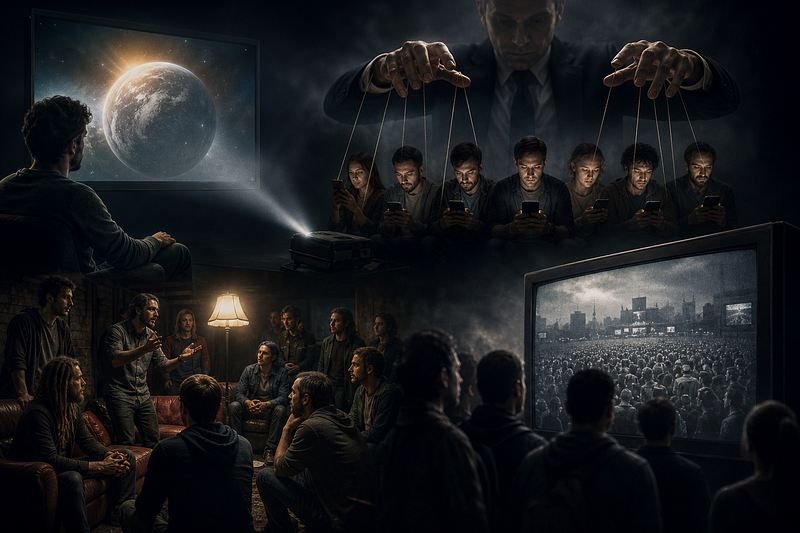
Now, every listener is a demographic of one.
We do not gather around sound; we consume it alone.
Rebellion became a private experience, something we feel rather than join.
The algorithm perfected capitalism’s oldest dream: individualism without solidarity.
You can be moved, enraged, enlightened, and still entirely alone in your reaction.
That is the real silence: not the absence of sound, but the absence of witnesses.
A protest unheard is not a protest. It is therapy.
The Digital Cathedral
Streaming platforms resemble churches now, endless hymns, infinite playlists, invisible priests deciding which songs receive grace.
Instead of confession, there are comments.
Instead of sacraments, subscriptions.
Instead of faith, feedback loops.
Every click is a prayer to the god of convenience.
Like all gods, this one demands obedience disguised as pleasure.
The faithful do not question what plays next; they let the machine decide.
The machine, built by men who worship metrics, delivers serenity instead of truth.
Some call it progress. Others call it what it is: the quiet death of cultural memory.
Echoes of the Old Prophets
There are moments, small ruptures when the old world flickers through.
A street protest chanting Kendrick’s “We gon’ be alright.”
A viral clip of Nina Simone resurfacing on a teenager’s feed.
A riff from Rage Against the Machine stitched into a video the algorithm failed to notice.
Even in captivity, truth leaks. It always does.
But these are echoes, not revolutions.
The system can tolerate echoes.
They keep people nostalgic without becoming dangerous.
The machine lets them live, just long enough to prove it is benevolent.
Every empire needs a song to pretend it still has a soul.
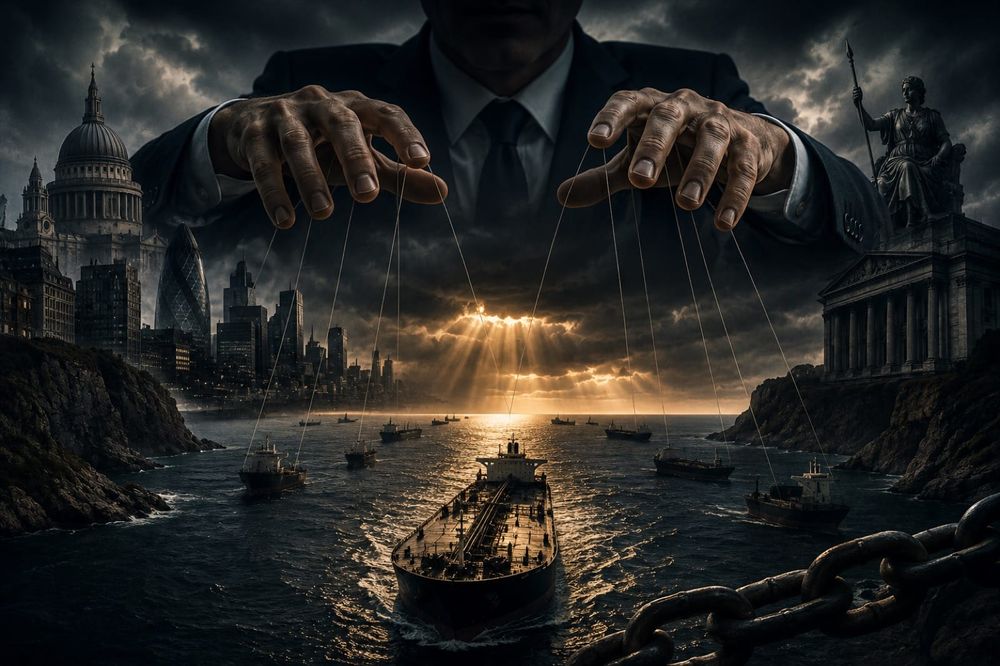
We are living through the quietest rebellion in history, a rebellion that never reaches the streets, never breaks a window, never changes a law, and plays endlessly through headphones while the world burns outside.
The algorithm hums like an indifferent god, patient, neutral, wrong.
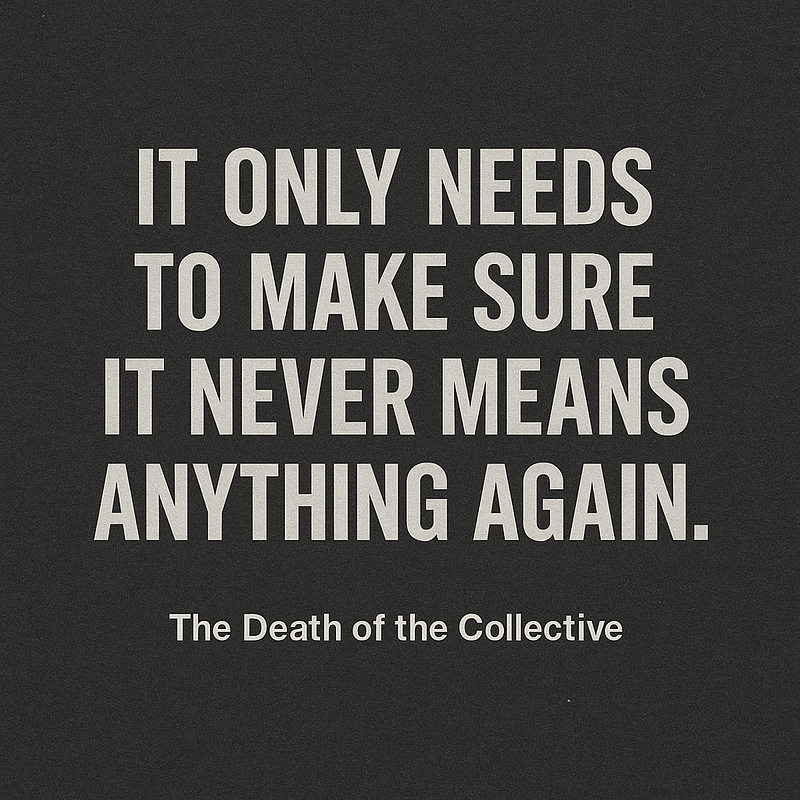
It does not need to stop the music. It only needs to make sure it never means anything again.
The Soul of Sound — Why Silence Is Political
Every civilization leaves behind its music.
Long after empires collapse and monuments fade, the songs remain — ghost frequencies of what a people once believed about themselves.
They are the most accurate record we have of moral temperature.
Because no one sings what they don’t, at least for a moment, think is true.
When those songs grow quiet, it is never coincidence.
Silence is not absence; it is strategy.
Authoritarians use it to erase dissent.
Corporations use it to standardize emotion.
Citizens use it to survive.
But silence, left long enough, begins to sound like consent.
Every empire teaches its citizens to hum instead of speak.
Music has always been our earliest form of democracy.
A single melody can unite strangers faster than any ideology.
It demands participation — a chorus, a crowd, a rhythm that insists we breathe together.
That is why power fears it.
Control depends on isolation; music dissolves it.
In every revolution, before the slogans and the manifestos, there was rhythm:
drums in Haiti, chants in Selma, guitars in Prague, beats in the Bronx.
Sound has always been the rehearsal for freedom.
Because to sing, even softly, is to admit you still have breath.
And breath is the first form of resistance.
The Political Grammar of Sound
When the world grows louder in machines and quieter in meaning, the simple act of listening becomes radical.
To listen deeply — not to entertainment, but to truth — is to reject the noise economy that governs attention.
Silence itself becomes political when it is chosen, not imposed.
But our silence today is not chosen. It is engineered.
We are not mute because we lack voices; we are mute because we are surrounded by sound that numbs instead of awakens.
The hum of constant media disguises the absence of music with meaning.
Noise is not the opposite of silence — it is its camouflage.
True silence is the space where truth prepares to speak.
If protest songs once measured moral courage, their disappearance now measures complicity.
We still have anthems for victory and grief, for nations and brands, but none for conscience.
We’ve lost the sound of disagreement — that dissonant chord that once reminded us freedom was unfinished.
Memory as Melody
Each era hides its truths in harmony.
The sixties carried faith in human change; the seventies, sorrow; the eighties, irony; the nineties, fatigue; the digital age, distraction.
You can hear the evolution of obedience in the production quality.
The cleaner the sound, the less it risks.
Our technology has perfected fidelity and murdered intimacy.
Listen to a live recording from the past — you can hear mistakes, breaths, feedback, tension.
That imperfection is not flaw; it is evidence of presence.
In that roughness lived honesty.
Now, perfection is policy.
No breath, no risk, no witness.
What does a culture lose when it no longer tolerates imperfection in its art?
It loses empathy — the ability to forgive what is human.
And empathy is the foundation of democracy.
Without it, freedom becomes an algorithm of convenience.
The Sound of Responsibility
If silence is political, then so is sound.
Each generation decides what kind of silence it will tolerate and what kind of sound it will risk.
To make music that matters is to confront that choice — to turn noise back into language, and pleasure back into purpose.
It means using the microphone not as mirror, but as mirror breaker.
Art is not supposed to comfort power.
It is supposed to discomfort obedience.
We cannot resurrect Dylan or Simone or Public Enemy, but we can remember what they proved:
that courage is contagious through rhythm.
That one honest line, sung at the right frequency, can still puncture propaganda.
And that no algorithm can write conviction.
Because truth, unlike data, has a heartbeat.
Epilogue | The Last Note
The room is almost silent now.
Only the faint vibration of an old speaker, the kind that still hums when the power is off.
It’s a sound you can feel more than hear — the ghost of voltage, the residue of rhythm.
Somewhere, a playlist keeps playing, perfectly shuffled, perfectly empty.
The voices of the past — Dylan, Lennon, Simone, Marley, Strummer, Chuck D, Kendrick Lamar — drift through the static like short-wave signals from another century.
Each one once believed that a song could still tilt the axis of history.
Each one discovered how heavy that belief can be.
The truth is never silent; it is only ignored.
Music did not die. It adapted.
But in adapting, it began to imitate what it once opposed.
The rebellion became entertainment, the protest became product,
and the song that once told the truth now sells the illusion of it.
The machine learned to hum in perfect harmony — and we mistook that harmony for peace.
Still, even machines misfire.
Every now and then, a note slips through that doesn’t belong — a raw chord, a human imperfection.
It startles the listener for a second, then fades,
but in that second something ancient flickers back to life:
the memory that sound was once a form of courage.
Some nights, when the world feels too managed, you can still hear it.
A street performer under a bridge, singing for no one in particular.
A teenager recording a verse in a bedroom, not for fame but for witness.
A protest chant breaking through police sirens.
None of it trends. All of it matters.
Because the opposite of silence isn’t noise. It’s meaning.
If protest music has vanished, it’s only because we stopped asking it to exist.
We asked for comfort instead of clarity, rhythm instead of reckoning.
But songs have long memories.
They remember every truth they once carried.
And one day — maybe not soon, but inevitably — they will remember again.
No silence lasts forever; it just waits for a listener brave enough to break it.
Perhaps the next revolution will not come from a stage or a studio but from a whisper —
one voice, honest enough to sound wrong.
That’s how every truth begins: off-key, out of place, unmistakably alive.
When that moment comes, we will recognize it instantly.
Because real music doesn’t entertain. It interrupts.
It doesn’t ask to be liked; it demands to be heard.
And once it is, the world around it can never return to quiet the same way again.
The last note of history’s songbook is still unwritten.
It waits — not for instruments, but for integrity.
For someone who believes again that sound can still tell the truth, even when no one wants to hear it.
And when that note finally comes — imperfect, unmarketed, unrepeatable —
it will remind us of something simple, something sacred, something almost forgotten:
A world without protest songs is not a world at peace.
It is a world that has forgotten how to listen.

Related Chapters from The Manifest
The Illusion of Peace: How Gaza Became a Permanent WarOn framing, image control, and how power turns peace into a stage. The same architecture that built the hype.
NATO: The Façade of Peace and the Architecture of PowerWhere propaganda hides behind diplomacy — proof that “false media” doesn’t just live on screens but in institutions.
The Fourth Reich: Echoes of Empire in AmericaHow power reinvents itself through entertainment, economy, and algorithm. The echo of hype in geopolitical form.