How a single sentence about seized Russian assets exposed the limits of Europe, NATO, and the United States and why this conflict began long before the first tanks crossed the border
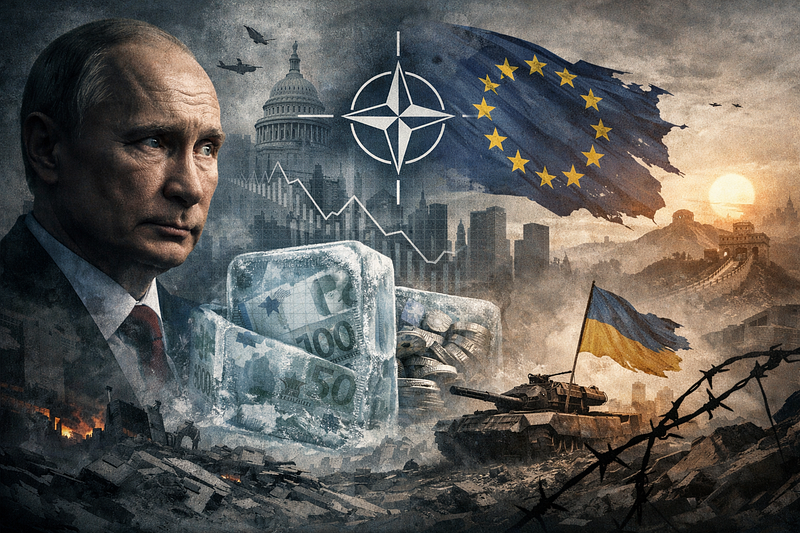
The Threshold Sentence
He did not raise his voice.
There was no dramatic pause, no effort to persuade, no attempt to rally an audience already fixed in its positions. The sentence was delivered with administrative precision. If Russian state assets were permanently confiscated, it would be treated as an act of war.
Not a threat.
A classification.
What made the remark notable was not its severity, but its timing. It came late, after months of silence, after sanctions had hardened into routine, after frozen assets had become an accepted feature of the financial landscape. It arrived not at the beginning of escalation, but at the edge of irreversibility.
This was not the language of momentum.
It was the language of thresholds.
This moment does not explain Vladimir Putin.
It explains the system that finally required him to speak.
The move from freezing to confiscation is not a technical adjustment. It is a transformation of category. Temporary measures can be reversed. Precedents cannot. Once assets are permanently seized, neutrality is not merely suspended. It is redefined.
Putin did not announce a future action. He registered a boundary already being approached by others.
Putin does not need to advance.
Time has been advancing for him.
This is not admiration.
It is geometry.
Stillness and Asymmetry
Power is often confused with initiative. Whoever moves first, speaks loudest, or escalates fastest is assumed to control the field. That assumption collapses when confronted with an actor whose strategic horizon is longer, whose domestic legitimacy does not depend on constant reaffirmation, and whose political memory includes systemic rupture.
For most of the war, Putin has not needed to speak at all. He has not needed to persuade, mobilize, or justify. He has not needed to match rhetoric with rhetoric or escalation with escalation. His posture has remained largely unchanged, while others moved around him, adjusting language, redefining red lines, and extending commitments whose end state was never named.
This asymmetry matters.
Power does not always reveal itself through action.
Sometimes it reveals itself through the ability not to act, while others exhaust themselves reacting.
When motion becomes compulsory, stillness acquires force.
Stillness, however, is not omnipotence. It does not eliminate risk, friction, or miscalculation. It merely shifts where uncertainty accumulates. Systems can hold longer than expected — and then fracture suddenly when strain redistributes.
To understand why this configuration favors endurance over urgency, it is necessary to step back — not to February 2022, but to the years in which reversibility quietly disappeared.
Where It Actually Began
The conflict did not move suddenly from stability to rupture. It passed through a sequence of closures, each framed as temporary, pragmatic, and reversible. Together, they formed a narrowing corridor in which escalation became structurally likely long before it became visible.
The first closure concerned security architecture.
After the Cold War, NATO expanded steadily eastward. This expansion was not accompanied by the construction of a parallel, inclusive European security framework capable of absorbing Russian security concerns as binding constraints rather than rhetorical acknowledgments. Strategic endpoints were never fixed. Expansion proceeded without a terminal design.
From one perspective, this was stabilization.
From another, encroachment without reciprocity.
This asymmetry did not produce immediate conflict. It produced uncertainty. And uncertainty, when sustained, becomes structural pressure.
The second closure concerned diplomacy.
Formats such as Minsk persisted long after their substantive capacity had eroded. Agreements were signed without enforcement mechanisms. Violations accumulated without consequence. Diplomatic process remained visible, but its function thinned.
This was the moment when diplomacy still existed — and then stopped existing as an option.
It did not collapse.
It simply ceased to alter outcomes.
The third closure concerned sanctions.
Initially deployed as calibrated instruments, sanctions accumulated without systematic evaluation of reversibility. Over time, they ceased to function primarily as leverage and began to operate as markers of identity. Once attached to moral positioning, sanctions became difficult to revise without reputational cost.
Policy adjustment turned into character judgment.
Reassessment became indistinguishable from retreat.
The fourth closure concerned time itself.
Measures introduced as exceptional were extended. Extensions became routine. Routine became baseline. Temporary arrangements hardened into standing conditions without explicit reauthorization.
At no single point was a final decision announced.
The system moved forward by exhausting alternatives without acknowledging their disappearance.
February 2022 marked a rupture — but not an origin.
Europe Without an Exit
Up to this point, this reconstruction assumes rational constraint.
That assumption deserves to be questioned.
Europe did not collapse under the shock of invasion. Institutions functioned. Summits convened. Statements were issued with ritual precision. Sanctions were renewed. Funding was extended.
From the outside, this looked like stability.
From the inside, it increasingly resembled constraint.
The defining absence was not capacity.
It was exit.
Europe committed itself to a posture without a terminus. Reversal was framed as betrayal. Reassessment as moral failure. Continuation, however costly, felt safer than admission.
Diplomacy did not fail spectacularly.
It receded quietly.
Talking would have meant admitting limits. Admitting limits would have required explanation to electorates primed for moral absolutism. Silence became safer than speech.
Silence did not indicate confidence.
It indicated fear of de-escalation.
This is where money enters the room.
Money as Continuation
When strategy falters, money arrives not as a solution, but as a solvent. It dissolves urgency, blurs responsibility, and postpones confrontation with limits.
Each funding round was framed as temporary.
Each extension as exceptional.
Together, they formed permanence.
Europe no longer asked whether the money would change the trajectory of the conflict. That question had become too dangerous. Instead, the question was reframed into something safer: can we afford not to pay?
When refusal becomes reckless, payment is no longer choice.
Alongside this financialization came the freezing of Russian state assets. Initially justified as extraordinary and temporary, the measure acquired a different gravity. Frozen assets generate pressure. Pressure drifts toward repurposing. Repurposing toward confiscation.
Permanent seizure is not sanctioning.
It is reclassification.
It converts financial instruments into weapons with memory. Once normalized, it cannot be confined to a single case.
This is where Putin’s sentence matters.
Not as threat, but as registration of a boundary the system itself had already drawn.
Europe chose another form of irreversibility.
The ninety-billion-euro loan to Kyiv preserves the appearance of control while deferring acknowledgment of loss. Loans presume solvency, continuity, and future capacity — conditions that cannot be verified in wartime.
This is not confidence in Ukraine’s financial reliability.
It is confidence in time as a solvent.
Ukraine, meanwhile, is not without agency. It exercises it tactically, not strategically — choosing endurance, shaping timing, and forcing costs upward even where it cannot define outcomes. This is limited agency, but it is real. It buys time for others even as it consumes its own.
What the World Sees
There was no immediate counter-declaration from Washington. No mirrored escalation from NATO. Legal reviews were cited. Consultations announced. Timelines deferred.
From the inside, this looked like restraint.
From the outside, it looked like hesitation.
And it was observed closely.
Not only in Moscow, but in Beijing, Delhi, Ankara, Riyadh, Brasília. By central banks and sovereign funds whose reserves still move through Western systems.
China, in particular, is not watching for who is right. It is watching for where limits appear, how long ambiguity is tolerated, and what precedents survive moral pressure. This conflict is not only a battlefield. It is a rehearsal observed by those who will operate in other theaters.
The signal they watched for was not escalation, but irreversibility.
That signal was not sent.
For now, the system holds at the edge.
What History Will Record
At this point, the analysis itself becomes uncomfortable.
Because the pattern revealed here does not require deception, ideology, or conspiracy. It requires only systems that continue to function after choice has narrowed, and actors who mistake continuation for responsibility.
If this structure holds, then no actor needs to want escalation for escalation to continue.
That sentence is not reassuring.
It is also not theoretical.
History rarely remembers periods like this by their speeches. It records what was postponed, what hardened quietly, and what became irreversible while attention was elsewhere.
It will also record the moments where prediction failed, where actors misread endurance as control, and where outcomes diverged from design despite careful sequencing.
This account, too, may prove incomplete.
What followed did not arrive suddenly.
It had been prepared for a long time.