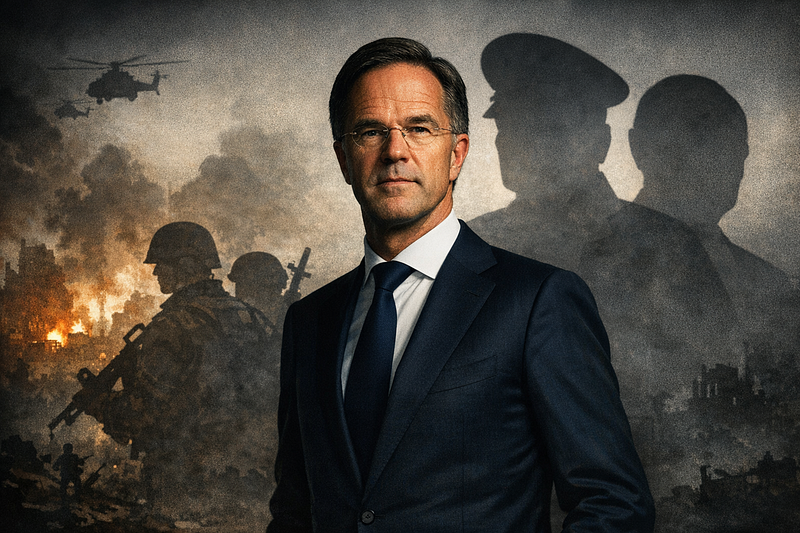
Whoever presents estimates as certainties in war
makes decisions over lives he himself will never lose.
This is not rhetoric.This is the bare reality.
The voice that leaves no space
When Mark Rutte speaks about Russia and the war in Ukraine, his language follows a fixed pattern.
Across speeches, interviews, and NATO appearances between 2022 and 2025, the same structure repeats.
Sentences are closed.
Moral framing is absolute.
Conditional language is absent.
Escalation is not presented as one option among others, but as necessity. Not as a political choice, but as an objective condition.
This is not temperament.
It is function.
In geopolitics, language does not merely describe reality. It defines the limits of what remains thinkable. Rutte’s language consistently contracts that space.
Numbers as instruments, not information
Rutte’s use of numbers follows the same logic.
Figures appear at moments where debate might otherwise remain open. Ammunition production, casualty totals, industrial output, timelines. The function is always the same: closure.
A recurring example is his claim, repeated in NATO contexts in 2024 and 2025, that Russia produces ammunition at a pace far exceeding that of NATO states combined. The statement is delivered as settled fact.
Yet publicly available defense assessments describe these figures as estimates, derived from partial intelligence, inferred industrial capacity, and modeling assumptions. No open-source dataset provides direct verification at the level of precision implied.
The distinction is not technical.
It is political.
In public speech, these figures are not framed as estimates with margins of error. They are framed as reality itself.
What is lost in this process is not accuracy, but truth itself. Not through error, but through conversion.
In war, that transformation matters immediately.
When uncertainty is compressed into certainty
The same compression occurs with casualty figures.
In late 2024 and throughout 2025, Rutte publicly referred to Russian casualties exceeding one million. He did not clarify methodological limits, verification gaps, or the distinction between killed, wounded, missing, or temporarily incapacitated.
Military analysts routinely stress that such figures carry wide uncertainty bands. Open-source projects tracking confirmed deaths explicitly warn that their numbers represent minimum confirmed cases only.
None of this appears in political speech.
Uncertainty is flattened.
Range becomes total.
Estimate becomes certainty.
This is not numerical error.
It is functional certainty.
And functional certainty accelerates decisions.
Often before they are recognized as decisions at all.
From certainty to decision
The transition from rhetorical certainty to concrete policy is not abstract. It is observable.
In early 2024, following repeated statements by NATO leadership including Rutte that ammunition shortages represented an “existential gap” and that Russian production vastly outpaced Western capacity, several European governments accelerated long-term procurement contracts and expanded defense budgets under emergency framing. These decisions were publicly justified not as strategic choices, but as unavoidable responses to an objective reality described in absolute terms.
In mid-2024, after continued public emphasis on casualty figures and escalation timelines, restrictions on diplomatic engagement were reinforced. Informal exploratory contacts were publicly discouraged and framed as weakness or appeasement rather than as instruments of de-escalation. The language preceded the policy. The policy followed the language.
By late 2024 and into 2025, the same certainty framing was used to normalize open-ended military commitments. Time horizons were removed. End conditions were left undefined. The war was no longer presented as a crisis to be resolved, but as a condition to be managed.
At no point were these shifts presented as political choices among alternatives. They were presented as technical responses to facts that “left no room.”
This is how certainty moves from speech into structure.
A brief pause
A number is spoken.
A headline follows.
Budgets move.
Weapons flow.
No one asks what was excluded from the number.
When claims are factually denied
The pattern extends beyond numbers.
In September 2025, Rutte stated in a televised interview that the Indian Prime Minister had contacted the Russian President and conveyed a warning aligned with Western pressure. Within hours, India’s Ministry of External Affairs publicly stated that this characterization was factually incorrect and that no such communication had occurred as described.
This was not a disagreement over interpretation.
It was a direct factual denial by the state involved.
The correction circulated briefly. The original claim remained embedded in the narrative environment.
This asymmetry is structural. Claims travel faster than corrections. Certainty outpaces verification.
The structural falsehood of inevitability
More consequential than any individual claim is the frame that holds them together.
Rutte repeatedly states that escalation is unavoidable and that alternatives no longer exist. This claim appears across interviews and speeches, often framed as realism.
It is demonstrably false.
Diplomatic channels between Russia, Ukraine, and NATO states have never ceased to exist. They have been politically sidelined, rhetorically delegitimized, and rendered unacceptable in public discourse. That is not the same as nonexistence.
By presenting political refusal as objective impossibility, choice is erased.
And when choice disappears, responsibility follows.
Why truth no longer plays a governing role
The deeper question is no longer who lies, but why truth itself no longer plays a governing role.
Modern power systems do not collapse because truth is absent. They function because truth has become optional.
What matters is not whether a statement is true, but whether it stabilizes the system, preserves alignment, and sustains belief.
Truth is not rejected because it is false, but because it interferes.
Anger as boundary enforcement
Rutte’s anger is not episodic. It is directional.
It appears most clearly when disruption enters the frame. Journalists asking about negotiation. Politicians raising concerns about escalation dynamics. Citizens questioning long-term consequences.
In these moments, tone hardens. Doubt is reframed as weakness. Questions are treated as moral deviation.
This is not emotional loss of control.
It is boundary enforcement.
Anger functions here as discipline. It marks which questions are permitted and which are not.
Asymmetry of exposure
Rutte speaks with certainty about war while remaining entirely outside its physical consequences.
This is not a moral accusation. It is a factual asymmetry.
He will not be mobilized.
His family will not be deployed.
His body will not enter a battlefield.
Decision-making occurs in a space where consequences are abstract and mediated. Responsibility is distributed across alliances, procedures, and moral frameworks.
No deployment orders are signed in this room.
In such a system, certainty carries no personal cost.
That is precisely why it becomes dangerous.
Why certainty kills time
The lethal effect of this mode of speech is not persuasion, but compression.
Each claim of inevitability removes pause.
Each absolute formulation narrows intervention windows.
Wars rarely begin with a single decision. They begin when hesitation disappears.
When time collapses, systems take over.
And systems that advance do not stop by themselves.
The erosion of belief
Across multiple European societies, trust in official war narratives is visibly weakening. This is reflected in polling volatility, declining confidence in political institutions, and growing public discomfort with open-ended escalation.
This erosion is not ideological revolt. It is explanatory failure.
Official language no longer accounts for lived reality. Militarization expands. Economic pressure mounts. Diplomacy vanishes from vocabulary.
The gap widens.
This phase is unstable.
When belief erodes but systems persist, power rarely responds with reflection. It responds with reinforcement.
Not a man, but a mechanism
This chapter is not a character study.
Mark Rutte appears here as a carrier function. A voice optimized for a system that rewards certainty, speed, and moral clarity while penalizing hesitation and ambiguity.
He is not exceptional.
He is selected.
Any system that treats uncertainty as weakness will elevate those who speak as if uncertainty no longer exists.
The echo that remains
Whoever presents estimates as certainties in war
makes decisions over lives he himself will never lose.
This is not moral outrage.
It is not polemic.
It is the description of a mechanism that has repeated itself across modern conflicts, with the same result each time.
As long as this mechanism remains unnamed, it will continue to operate.