Introduction, the order that mirrored Rome
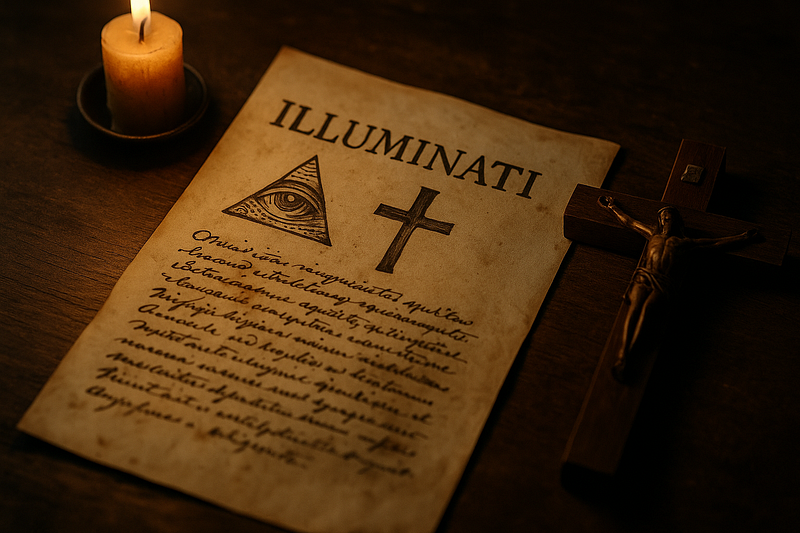
On a spring day in 1776, in a Bavarian classroom, Adam Weishaupt founded a society that would one day become the most famous secret order in the world. He called it the Illuminati. Since then their name has glowed in whispers, from conspiracy theories to pop culture, from novels to neon stages. People know the symbol — the eye in the triangle — but few know what the Illuminati really were.
History remembers them as rebels against crown and church, architects of revolution, shadows behind uprisings. Yet the reality was stranger. Weishaupt had been trained in Jesuit classrooms, the Vatican’s most disciplined halls. The hierarchy he built was not invention but imitation. The Illuminati were never pure rebellion. They were a mirror, cast in the shape of Rome.
“The order that promised to overthrow the Church bore the shape of the Church itself.”
This paradox is their true legacy. Outlawed yet enduring, condemned yet imitated, mocked as myth yet embedded in power. To understand the Illuminati is to move beyond the cartoon and face the structure they carried — a design older than their name, and still alive in the shadows today.
The Jesuit blueprint, classrooms of obedience
The birth of a different order
In 1540, the Society of Jesus was born under Ignatius of Loyola. They were not monks cloistered in silence. They were soldiers in cassocks, trained for courts, classrooms, and kingdoms. Rome gave them a mission: to spread faith with precision, to defend the Church with discipline sharper than any sword.
The Jesuits rewrote what it meant to be a religious order.
“The Superior General commanded like a general, and obedience flowed like water down a pyramid of power.”
The pyramid of discipline
At the top stood the Superior General, the so-called Black Pope. Orders descended in silence, reports rose with precision. No army rivaled their structure. Hierarchy was not debated, it was embodied. The system was designed to endure beyond individual men.
For more than two centuries they expanded into schools, missions, and courts. They shaped kings, advised emperors, and ran universities that trained the elite. Their classrooms produced obedience as much as knowledge.
Weishaupt’s inheritance
When Adam Weishaupt studied in Ingolstadt, he absorbed this world. Even after the Jesuits were suppressed in 1773, their shadow lingered in the city’s classrooms. Weishaupt carried their methods into his own creation.
Cells nested within cells. Degrees of secrecy. Obedience masked as enlightenment. The Illuminati statutes mirrored the Jesuit rule almost line for line.
The Illuminati were not born in rebellion. They were carved from the mould of the Jesuits.
The Church and the Lodge, blurred lines of opposition
Lodges as rivals
Eighteenth-century Europe hummed with Freemason lodges. To outsiders they looked like harmless clubs of fraternity and ritual. Inside, ambition and secrecy intertwined. Their symbols drew on ancient geometry, their oaths promised loyalty above nation or creed.
Rome thundered against them. Papal bulls condemned Freemasonry as heresy, excommunicating members who dared to enter their halls. The official narrative was clear: Church against Lodge, altar against compass.
Yet boundaries rarely stayed where Rome drew them.
“The lines between Church and Lodge were never as bright as Rome proclaimed. Shadows crossed both walls.”
Overlaps of power
Nobles who funded monasteries also financed lodges. Priests whispered Masonic oaths in secret while condemning them from pulpits in daylight. The eye, the sun and moon, the geometry of creation — symbols overlapped until it was unclear who borrowed from whom.
The struggle was presented as war, but in practice it was a mirror game: denunciation on one stage, infiltration on the other.
The Illuminati’s burrow
Weishaupt saw opportunity in the blur. The Illuminati did not build new lodges, they burrowed into existing ones. Rituals were reshaped, networks re-directed. Soon Germany’s lodges were filled with men who swore one oath in public and another in secret.
What looked like rebellion from the outside was absorption from within. The Illuminati thrived by inhabiting contradictions: Church condemning lodges, lodges sheltering new orders, all bound together by secrecy.
Opposition itself became the raw material of power.
The mask of opposition, rebellion as theatre
Rome’s double voice
Rome had long mastered the art of speaking with two voices. One condemned, the other shaped. By denouncing enemies in public while guiding them in private, the Church ensured no movement strayed too far from its orbit. Control was never only about loyalty. It was about scripting the appearance of rebellion itself.
To tame revolt, the most enduring strategy is to write its script.
“The most enduring way to tame revolt is to script it yourself.”
Illuminati as perfect adversary
The Illuminati fit this pattern seamlessly. They appeared as rebels against throne and altar, promising a world freed from priestly chains. Yet their structure betrayed a deeper loyalty to older designs. Hierarchies disguised as enlightenment, obedience masked as freedom — these were Jesuit fingerprints transposed into a new key.
Their defiance was rehearsed in the grammar of obedience. Their independence was staged inside a script inherited from Rome.
Rebellion as mask
What looked like rupture was continuity. The Illuminati did not overturn the order of power. They imitated it, mirrored it, carried it forward under another name.
Condemned in proclamations, tolerated in practice, they became the mask of opposition. They allowed Rome to hold both sides of the play: the altar and the rebellion, the denunciation and the infiltration.
Rebellion became theatre. Opposition became instrument.
From Ingolstadt to the world, outlawed yet immortal
The crackdown
In 1785, Bavarian authorities outlawed the Illuminati. Weishaupt fled into exile, cells were raided, papers seized. On parchment the story ended. Officials announced that the order was dismantled, its leaders disgraced, its rituals exposed.
But secret orders do not vanish by decree.
To destroy the name is not to erase the method.
“A society need not exist everywhere. It need only be believed everywhere.”
The spread of cells
By the time the ban came, the Illuminati had already tunneled deep into Masonic lodges across Germany. Their statutes lived in whispered rituals, their oaths in private chambers. Even as governments cracked down, fragments of the design moved onward — to Parisian salons, to London debates, to pamphlets passed in shadow.
Whispers spread that Illuminati hands had stormed the Bastille. In London, critics accused them of steering revolution. By the nineteenth century the name had become a vessel for fear: invoked to explain unrest, blamed for conspiracy, woven into the imagination of Europe.
The birth of a legend
The Illuminati as an organisation disintegrated. The Illuminati as a myth multiplied. They became less a brotherhood than a cipher into which every anxiety could be poured. Outlawed, they were immortalised.
The name dissolved, the method endured.
The Vatican web, P2 lodge, Ambrosiano, and the shadow of Rome
The secret archive
To understand why the Illuminati’s shape endured, one must turn to Rome. The Vatican’s power rests not only on faith but on secrecy. Its archives stretch for miles beneath the city, filled with treaties, condemnations, instructions never meant for the public eye. What was declared in pulpits was only half the story.
Rome’s true strength lay not in proclamation, but in concealment.
“Silence is not the absence of answers. It is the control of questions.”
The scandal of P2
In the 1980s, the Propaganda Due lodge — better known as P2 — pulled back the curtain. This was no ordinary Masonic circle. Its members were ministers, generals, spies. It was a parallel government sworn to secrecy, tied by oaths and rituals that echoed both Masonry and Jesuit discipline.
When it was exposed, investigators found connections reaching into the Vatican Bank itself. The same Church that had thundered against lodges was entwined in their finances. Two stages, one script: denunciation in daylight, complicity in shadow.
Banco Ambrosiano and God’s banker
The scandal deepened with the collapse of Banco Ambrosiano, the Vatican’s most trusted financial partner. Billions vanished. Roberto Calvi, known as “God’s banker,” was found hanging beneath Blackfriars Bridge in London. Officially suicide. Almost no one believed it.
The Illuminati did not need to survive as one order. Their design lived on in the Church that birthed them.
The pattern revealed
The mask of opposition repeated itself. Public condemnation of corruption, private entanglement in its profits. Lodges, banks, orders, all framed as external enemies, yet drawn into Rome’s orbit. The method was unchanged: absorb, reframe, control.
Jesuit blueprints in the modern world, from universities to intelligence
The classroom as forge
The Illuminati as an order dissolved, but the Jesuits endured. Their classrooms continued to shape elites long after Weishaupt fled. Georgetown in Washington, the Gregorian in Rome, Boston College in Massachusetts — each trained politicians, financiers, and intelligence officers. Loyalty was not to slogans of democracy, but to structures of hierarchy and discipline.
The Jesuit classroom remained the original training ground of hidden orders.
“Obedience taught in silence survives longer than revolutions shouted in streets.”
The transmission of method
The mechanics were simple and enduring. Small groups bound tightly. Information flowing upward, not outward. Hierarchies disguised as collegial networks. The same design that shaped the Illuminati lived on in seminaries, lecture halls, and ministries.
Corporations imitated it. Intelligence agencies perfected it. CIA, MI6, Mossad, the KGB — all evolved structures of secrecy that echoed Jesuit blueprints. Compartmentalisation, deniability, obedience: the same code written in new institutions.
From pulpits to power
Graduates of Jesuit schools filled the corridors of governments and banks. They became presidents, judges, spymasters. They did not call themselves Illuminati. They did not need to. The skeleton of the design moved quietly through them, shaping decisions, scripting oppositions, preserving the same silent discipline.
The name faded. The architecture remained.
Illuminati as distraction , pop culture vs real power
The cartoon of conspiracy
Today the word Illuminati glows in neon. A rapper flashes a triangle, a pop star sings beneath a giant eye, Hollywood turns the secret order into spectacle. The name is everywhere, yet emptied of substance.
It would be comic if it were not so effective. By reducing the Illuminati to a meme, the deeper structures slip from sight. The cartoon distracts. The institutions endure.
“The greatest trick of power is to make its shadow into a cartoon.”
The real inheritance
The Jesuit mould, the Vatican’s archives, the networks of finance and intelligence, these are not jokes or stage props. They are the continuation of a design older than the Illuminati’s brief existence. Rebellion scripted, opposition absorbed, secrecy institutionalised.
The Illuminati as an order are gone. But their architecture remains alive in universities, agencies, banks, and courts.
Closing reflection, the mirror in the shadows
The Illuminati endure as a phantom. They are blamed for revolutions, mocked in pop songs, conjured in novels. Yet their true story is sharper.
They were not rupture but inheritance. Born in Jesuit classrooms, structured by Vatican discipline, they repeated the order they claimed to oppose. Condemned in public, absorbed in private. Outlawed on paper, immortalised in practice.
Rome does not need to invent conspiracies. It needs only to cast shadows long enough that we mistake them for enemies.
And in that theatre, it remains what it has always been: the stage where power writes both sides of the play.
“When memory outlives history, the design endures.”