From sealed archives to buried ruins, from Tesla’s lost inventions to digital erasure, how power wages war not only on the present, but on memory itself.
Power does not only fight for the present. Its deeper battle is over the past and over the futures we are denied.
What we are told to remember, and what we are forced to forget, defines the horizon of imagination.
This is not history as neutral record. It is history as weapon. From the withheld JFK files to the omissions of 9/11. From erased civilizations and curated museums to the suppression of Nikola Tesla’s inventions. Memory itself has become a battlefield.
This essay is not a standalone text. It is part of the Manifest, a wider project that maps how elites design power through crisis, fear, law, silence and erasure. The war on memory is one chapter in that unfolding story.
Sealed archives, broken trust
History is not only written in books. It is hidden in locked drawers.
For sixty years the JFK files have been postponed. Each time the reason was “national security.” The truth was not destroyed, but delayed until witnesses were gone and questions lost their urgency.
The 9/11 Commission followed the same script. The images of collapse were replayed endlessly. Testimonies of explosions disappeared from the report.
Investigations became curation. Evidence was trimmed until it fit the needs of power.
Trust does not collapse because people doubt everything. It collapses because they see what has been deliberately withheld.
Lost civilizations, forbidden questions
If archives erase decades, history books erase centuries.
Schools present civilization as a straight line: Mesopotamia, Egypt, Greece, Rome, and then us.
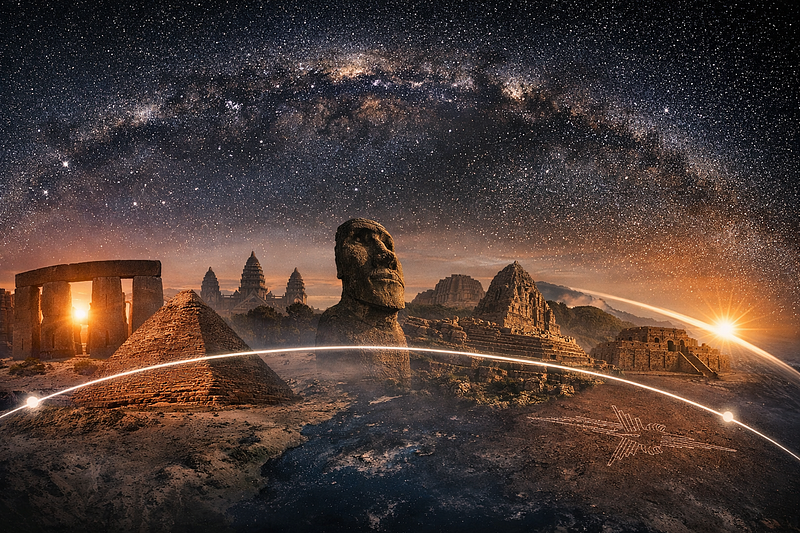
Yet ruins, maps and oral traditions suggest another story. Advanced cultures erased from the timeline.
The word Tartaria is mocked as fantasy, but architecture across continents refuses to fit the official chronology.
Allegations persist that the Smithsonian hid giant skeletons. The Vatican sealed manuscripts. UNESCO decides which ruins count as “world heritage.” The British Museum dazzles with treasures while hiding the violence that brought them there.
These institutions do not merely preserve. They filter.
A skeleton that breaks the evolutionary model. A map that charts forbidden lands. An inscription that predates accepted history. Each risks being buried, silenced or dismissed as forgery.
The museum becomes theater: a memory palace with entire wings locked away.
“The museum becomes theater: a memory palace with entire wings locked away.”
To forget these possibilities is not to protect truth. It is to limit imagination.
A people who cannot remember that others once built differently cannot imagine that we might live differently today.
The erased origins
Perhaps the deepest front in the war on memory is the story of where we come from.
Our origins have been trapped between two official frames: the Biblical story of divine creation and Darwin’s ladder of evolution. One turns myth into dogma. The other reduces existence to chance. Both are presented as complete, yet both leave vast silences.
Flood myths appear on every continent. They describe civilizations destroyed by cataclysms.
Mainstream science treats them as coincidence, folklore at best. Yet geology reveals sudden layers of catastrophe.
What if these were not inventions, but memories?
Archaeological finds hint at humans far older than textbooks allow. Out-of-place artifacts, tools, carvings and even fossils suggest advanced cultures in deep time.
Göbekli Tepe in Turkey, built over 10,000 years ago, shows organized architecture and astronomy. It is treated as an anomaly, not as evidence that our entire chronology may be flawed.
Even the Great Pyramid of Giza carries clues that contradict the official story. Its proportions encode the golden ratio, a mathematical constant celebrated millennia later by the Greeks but seemingly embedded in stone long before their time.
Mainstream scholars dismiss this as coincidence. The precision suggests otherwise.
If this knowledge had been studied, understood and passed forward, human civilization could have advanced centuries ahead of where we are today.
Instead, such traces are dismissed, hidden or sealed away. We are left to rediscover slowly what others may have mastered long before us.
What has been erased is not only history, but possibility. Mathematics written in stone. Astronomy mapped in ruins. Technologies that could have changed the trajectory of our species.
“To forget origins is not only to lose memory. It is to live in the shadow of what we could already have been.”
Suppressed knowledge and hidden technology
The erasure of civilizations is matched by the suppression of invention.
Power not only edits the past. It also edits the future.
Nikola Tesla dreamed of wireless energy, towers transmitting power without oil, coal or grids. His Wardenclyffe Tower was demolished and his notes seized.
Official history reduces him to eccentric genius. His ideas threatened entire industries.
The same fate met others.
Viktor Schauberger explored implosion energy. His research was confiscated. Royal Rife developed frequency devices for disease. His lab was destroyed. Wilhelm Reich investigated “orgone energy.” His books were burned by U.S. authorities.
Even now, patents on alternative propulsion vanish under “national security” orders.
If even fragments of this suppressed knowledge had been released, the world would look unrecognizable. Tesla’s energy, Schauberger’s implosion, Rife’s medicine.
Wars for oil may never have been fought. Entire industries of dependency may never have existed.
By conservative measure, humanity is decades behind where it could be. By bolder reckoning, we may be living a century behind our true potential.
“By conservative measure, humanity is decades behind. By bolder reckoning, we may be a century behind our true potential.”
That gap is no accident. It is design.