The Map That Promises Too Much
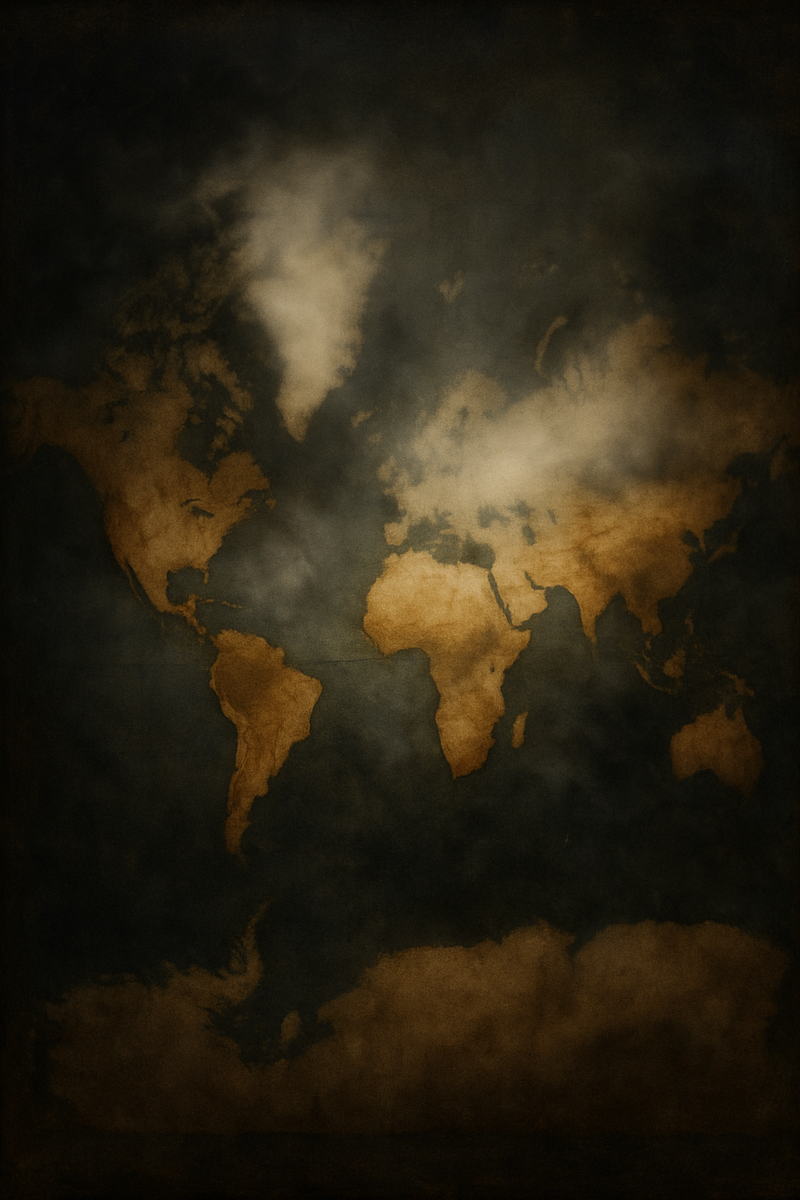
A classroom map hangs perfectly flat against the wall. Continents are colored. Borders are calm. Oceans are empty blue. Nothing resists the eye.
At some point, usually without noticing, the map migrates from wall to hand. A phone screen replaces the paper. You pinch, zoom, rotate. The promise remains the same.
Then the image hesitates.
You zoom into a jungle basin, a polar shelf, a desert interior. Roads vanish. Texture dissolves. The interface apologizes without explanation. Image not available at this resolution.
No error code. No warning.
The gesture was ordinary. The interruption was not.
This is not error.
This is selection.
A map does not show the world. It shows what remains after permission.
Some places are not absent because they are dangerous. They are absent because they destabilize sequence. They introduce depth where the timeline requires flatness.
In 1946, five thousand American personnel, thirteen ships, submarines, and aircraft carriers moved south under the name scientific research. Operation Highjump was described as training. Its structure was military. Its ending abrupt. Its records sealed.
Silence followed not as absence, but as signal.
Certain places on Earth are not explored. They are administered.
This chapter begins where administration replaces curiosity.
Not in geography.
But in the negative space beneath it.
The visible Earth is only the permitted Earth.
Where Nature Functions as a Curtain
Nature is often blamed for what is missing. Jungle too dense. Ice too thick. Sand too hostile.
This explanation comforts institutions. It shifts causality away from decision and into environment, as if geography itself were responsible for silence.
But difficulty has never stopped empire. It has only changed the paperwork.
What matters is not whether a place can be reached, but whether its contents can be absorbed without fracturing the story that precedes them.
The Amazon — The Canopy That Edits History
From above, the Amazon looks eternal. A green surface without interruption. A biological infinity that appears hostile to permanence.
For centuries, scholarship called it empty. Untouched. Incapable of supporting large-scale civilization. Textbooks repeated this until it hardened into fact.
Then lidar pierced the canopy.
Geometric earthworks surfaced. Straight roads beneath vines. Causeways spanning floodplains. Irrigation grids where maps showed nothing. Urban layouts once dismissed as fantasy reappeared as engineering.
The forest had not erased the past.
It had been allowed to cover it.
What followed was not celebration but management. Restricted flyovers. Slowed publication. Fragmented releases stripped of scale and continuity.
The canopy does not hide nature.
It hides a version of humanity that contradicts developmental hierarchy.
A civilization capable of reshaping an ecosystem at scale does not fit comfortably beneath the story of linear progress.
Access was never limited by difficulty. It was limited by approval.
The Sahara — The Archive Beneath Sand
The Sahara is described as absence. A terminal landscape. A place where history ends.
Six thousand years ago, it was neither.
Rivers crossed it. Lakes expanded and contracted. Human settlement followed water in predictable patterns.
Radar reveals riverbeds wider than the Nile, fossil shorelines, subsurface geometries that resist randomness.
The clearest signals align with restricted regions. Southern Algeria. Northern Mali. The Fezzan Basin.
Excavation here is rare. Permits stall. Data remains partial.
Sand does not destroy.
It seals.
The Sahara is not the largest desert on Earth.
It is the largest sealed archive.
Burial is a form of preservation.
Antarctica — Custody, Not Emptiness
Antarctica performs innocence.
White suggests untouched. Treaties suggest care. The language of preservation masks the language of control.
No private settlement is allowed. No sovereign claim permitted. A continent larger than Europe held in permanent suspension.
This is not preservation.
It is custody.
Beneath ice lie valleys larger than nations. Mountain ranges rivaling the Alps. Subglacial lakes sealed for millions of years.
Lake Vostok was breached once.
The public received a summary.
The raw data vanished.
Since Highjump, expeditions follow a fixed rhythm. Access rationed. Oversight constant. Outputs filtered.
Antarctica does not hide through ice.
It hides through agreement.
Memory that predates the timeline requires management.
Elevated Silence
Altitude does not only thin air. It thins jurisdiction.
Mountains interrupt logistics, communications, and control. They create pockets where continuity weakens and older layers surface.
This is why high places attract both mysticism and restriction. Not because they are sacred, but because they are difficult to normalize.
The Himalaya and Tibet — Altitude as Filter
The Himalaya is a geological barricade.
Behind it lies a plateau where access becomes ritualized. Permits replace exploration. Escorts replace inquiry.
There are valleys absent from public maps. Zones where GPS degrades. Satellite frames downgrade precisely where archaeology complicates sovereignty.
Every discovery here destabilizes more than chronology.
It destabilizes jurisdiction.
Silence is not lack of information.
It is enforced stewardship.
The higher the terrain, the tighter the narrative.
The World Beneath Water
The ocean is treated as emptiness because emptiness is administratively useful.
An uninhabited domain requires no historical accounting. No ancestry. No displacement.
But the seafloor is not blank. It is structured, layered, scarred by movement older than land-based chronology allows.
The Oceans — Where the Map Goes Blind
Seventy percent of Earth lies underwater.
Its public maps are softer than those of Mars.
Civilian bathymetric charts flatten peaks and compress trenches. Sharp ridges appear rounded. Large structures dissolve into noise. The justification is always technical. Resolution limits. Cost. Complexity.
Naval charts do not suffer from these limitations.
In 2014, a civilian research vessel conducting sonar mapping over a mid-ocean ridge recorded a series of angular returns inconsistent with volcanic formations. The data was logged. The pattern repeated.
Within hours, the ship received a routine transmission. Course adjustment requested. Naval exercise in progress. Thirty nautical miles east.
No threat. No force.
The crew complied.
The raw sonar file was flagged for review. The publicly released dataset months later showed a smoothed ridge profile. The angular returns were absent.
Nothing was falsified.
Resolution was simply reduced.
The drowned world is not unknown.
It is withheld.
Emptiness is the most useful fiction.
When Continents Disappear
The idea that land is permanent underpins most historical timelines.
Once that assumption fails, history destabilizes.
Doggerland beneath the North Sea. Sundaland beneath Southeast Asia. Zeelandia acknowledged only recently. Greater Adria crushed beneath Europe.
Land does not require myth to vanish.
Only water.
If continents can disappear within human memory, civilizations can vanish without collapse.
This is the hinge.
The Earth deletes chapters.
We mistake the gaps for simplicity.
History shortens when geology is ignored.
Cities That Forget Vertically
Urban expansion does not erase the past through destruction, but through compression.
Layer accumulates on layer until excavation becomes liability rather than inquiry.
In 2016, construction of a metro extension beneath a European capital broke through an undocumented chamber. Stonework predating the known settlement phase. Tools embedded in silt. No signage. No record.
Work stopped.
A temporary barrier was erected. An assessment followed. The chamber was deemed unstable.
Concrete was poured.
The incident appeared briefly in a municipal report under the category engineering delay. No archaeological addendum followed.
Cities do not lack history.
They lack clearance.
Modernity is built by covering, not by clearing.
Neutrality as Architecture
Neutrality is often framed as moral distance. In practice, it is spatial design.
Certain geographies are engineered to outlast collapse by embedding function into stone rather than policy.
The Alpine Vault
Switzerland’s mountains are not scenery.
They are infrastructure.
Vaults carved in granite. Data centers embedded in stone. Archives immune to collapse above them.
Neutrality is not ideology.
It is engineering.
CERN sits aligned with geology, not capitals.
Switzerland does not store wealth.
It stores continuity.
Polar Editing
Blankness is not absence. It is a deliberate aesthetic.
White simplifies. It discourages detail. It resists scrutiny.
The poles are rendered neutral long before they are rendered remote.
The Arctic appears blank because blankness is effective.
Greenland’s canyons dissolve into white. Satellite updates slow. Frames revert.
Submarines traverse corridors absent from maps.
The poles are not remote.
They are curated.
Antarctica hides what the Earth was.
The Arctic hides what it is becoming.
The future requires silence.
The Sky That Filters
The myth of total visibility is one of the great comforts of the satellite age.
We are told that nothing can hide anymore.
After a major archaeological survey in Central Asia in the early 2000s, publicly available satellite imagery of the region quietly reverted to older frames. Resolution dropped. Temporal updates slowed.
No announcement was made.
When independent researchers compared archived imagery to newer releases, the difference was measurable. Structures previously visible were now indistinct.
The explanation cited licensing changes.
Nothing was removed.
Clarity was simply withdrawn.
The sky does not watch.
It moderates.
Visibility follows narrative tolerance.
The Custodians
Silence does not emerge organically.
It is produced.
A researcher files a request for raw survey data from a publicly funded expedition. The reply arrives weeks later. Data available in summarized form. Raw files restricted pending review.
No denial.
Just delay.
Military mapping precedes civilian release. Intelligence agencies classify anomalies as noise. Scientific institutions publish fragments compatible with existing frameworks. Treaties regulate access using neutral language that never mentions memory.
The custodians are not villains.
They are stabilizers.
They maintain coherence by deciding what may appear before the timeline can absorb it.
What cannot be integrated must be delayed.
Pattern Recognition
Jungle. Desert. Ice. Ocean. Mountain. City. Vault. Pole.
Different climates.
Same choreography.
Where memory deepens, visibility decreases.
Forbidden zones are not anomalies.
They are pressure valves for the story of humanity.
The Map Ends, the World Does Not
The Earth is not a surface.
It is a manuscript written in layers.
Oceans erase. Deserts seal. Ice suspends. Cities overwrite.
The present is a thin page placed atop forgotten volumes.
A small world is easy to govern.
A deep world resists.
Once you notice where the map goes thin, you cannot unsee it.
The map ends here.
The world does not.
The story is longer than we were taught.