The sentence that could no longer be written
There was a time when the sentence existed.
Not hidden.
Not coded.
Not whispered.
Just written.
The Azov Battalion has neo-Nazi roots.
It appeared in mainstream Western outlets without drama. As a clause, not a thesis. As background, not accusation. It sat alongside dates, troop movements, and political context. Editors approved it. Fact-checkers passed it. Readers absorbed it and moved on.
That sentence did not trigger outrage.
It triggered understanding.
Then, sometime after February 2022, the sentence vanished.
No correction followed.
No retraction was issued.
No new evidence disproved it.
It simply became unwritable.
Nothing was being exposed. It was already visible.
Before the silence
After the Maidan uprising in 2014, Ukraine entered a period of fragmentation. State authority weakened, the army was underfunded, and war in the east erupted faster than institutions could respond.
Into that vacuum stepped volunteer battalions.
Western reporting at the time was direct. Journalists described Azov as far-right, ultranationalist, and ideologically extreme. Reuters photographed fighters wearing Wolfsangel insignia. The Guardian interviewed commanders who spoke openly about ethnic nationalism. Human Rights Watch and Amnesty documented abuses committed by volunteer units, including Azov and Aidar, with the same clinical tone they used elsewhere.
Nothing about this was sensational.
It was normal reporting.
The administrative solution
The first transformation was not moral.
It was bureaucratic.
Ukraine began integrating volunteer battalions into formal state structures. Azov was absorbed into the National Guard. The official rationale was discipline, hierarchy, and control.
Western language adjusted.
Azov no longer is, but was.
No longer neo-Nazi, but with far-right origins.
No longer extremist, but controversial.
This was not denial.
It was temporal distancing.
The past was acknowledged, then placed behind glass.
At the same time, institutions betrayed awareness in another register. The U.S. Congress introduced explicit bans on military aid to Azov. These restrictions were debated, softened, reintroduced, diluted.
States do not legislate around myths.
February changed the grammar
February 2022 did not only change the battlefield.
It changed the grammar of legitimacy.
Ukraine became the frontline of a broader confrontation. The war was framed as civilizational. And civilizational wars do not tolerate internal contradiction.
Language hardened into alignment.
The conflict became democracy versus authoritarianism, freedom versus tyranny, light versus dark. In such a structure, nuance is not false.
It is destabilizing.
References to Azov’s ideological origins did not provoke rebuttal.
They provoked discomfort.
So they disappeared.
Silence without decree
No editor issued a ban.
No ministry sent instructions.
The mechanism was quieter.
Journalists learned which sentences delayed publication. Editors learned which paragraphs raised “context concerns.” Producers learned which guests complicated panels.
The system adjusted itself.
This is how modern censorship works.
Not through prohibition, but through anticipation.
The most efficient filter is the one no one has to enforce.
The other names that disappeared
Azov was not an anomaly. It was the most visible node in a longer ideological line that Western reporting once acknowledged and then quietly abandoned.
For years, journalists and historians wrote openly about the legacy of Stepan Bandera and the Organisation of Ukrainian Nationalists. Bandera’s OUN-B faction collaborated tactically with Nazi Germany against the Soviet Union. Its armed wing, the UPA, was implicated in ethnic cleansing campaigns against Polish and Jewish civilians.
This was not fringe history.
It was established scholarship.
Before 2022, Bandera existed in Western reporting as a problematic nationalist figure, framed simultaneously as anti-Soviet resistance and as an ideologue linked to atrocities.
After 2022, the tension vanished.
Statues remained.
Street names remained.
Context did not.
Symbols without explanation
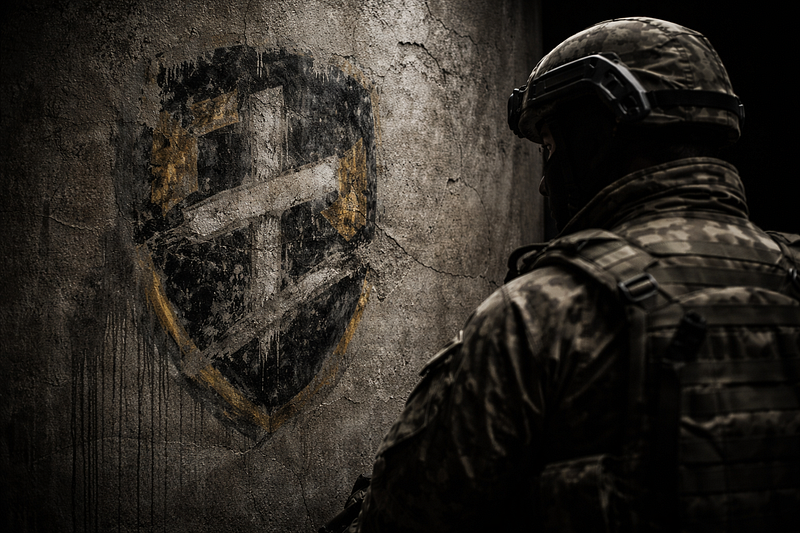
Photographs from the mid-2010s showed Azov fighters wearing insignia directly traceable to Nazi iconography. The Wolfsangel appeared repeatedly. The Black Sun surfaced in patches and tattoos.
These images were published without interpretation. None was required.
Over time, insignia were modified or removed from official uniforms. The aesthetic shifted.
The record did not.
Symbols did not stop existing.
They stopped being explained.
The symbols were removed from uniforms, not from history.
They also policed their own
These groups did not only fight external enemies.
They also targeted Ukrainians.
Between 2014 and 2019, far-right militias attacked political opponents, journalists, Roma communities, LGBTQ gatherings, and anti-war activists. Human rights organizations documented these incidents repeatedly.
The victims were Ukrainian citizens.
The violence occurred in Ukrainian cities.
This mattered because it revealed a second function.
They did not only fight enemies. They policed the nation itself.
That detail disappeared fastest of all.
The intelligence question
There is no evidence that Western intelligence services ideologically supported neo-Nazi groups.
That claim collapses under scrutiny.
But there is compelling evidence that Western intelligence accepted an operational environment in which such groups existed and chose not to make that a dealbreaker.
Training, intelligence cooperation, and military support for Ukrainian security structures continued after 2014, despite full awareness of ideological contamination within parts of that ecosystem.
This is not conspiracy.
It is doctrine.
Western intelligence did not create these groups. It decided they were not disqualifying.
Why this remains alarming
What makes the presence of visible neo-Nazi ideology in modern armies alarming is not scale.
It is recurrence.
Across countries and decades, the same pattern appears. Extremist individuals enter armed forces. Symbols surface. Investigations follow. Measures are announced.
And then the system moves on.
Not because the issue was resolved.
But because something else became more urgent.
A problem that keeps returning after it is acknowledged is no longer accidental.
The institution always knows
There is a comforting myth that extremist infiltration is something institutions discover.
That is rarely true.
What happens instead is recognition without confrontation. Awareness without resolution. Files are opened, then parked. Names circulate, then stop circulating.
Institutions do not forget.
They defer.
Institutions do not forget. They defer.
The cost of postponement
Deferral works only as long as language remains intact.
As long as things can be named, categorized, debated. The moment naming becomes politically expensive, deferral hardens into silence.
From that moment on, extremism no longer needs protection.
It needs only absence of friction.
What remains is residue.
And residue always returns later, rebranded as surprise.
What remains when words are gone
The most unsettling part of this story is not what was revealed.
It is what became unsayable.
Not because it was false.
But because it complicated alignment.
Wars end.
Institutions endure.
Language loosens.
And when it does, the old sentences return. Not as discoveries, but as reminders.
What cannot be removed in reality is removed in language.
Remember always where it truly began.
And remember who decided that some truths could wait.