The Day After the Fall
Attention was elsewhere.
It was Christmas Day. Newsrooms ran on skeleton crews, diplomatic channels paused, markets closed. Nothing about the date suggested urgency. The sense was not that history was unfolding, but that it had already concluded its business. Eight years earlier, this same day had been used to close a chapter. An empire had been lowered from a flagpole. A century had been declared finished.
This time, no meaning was anticipated.
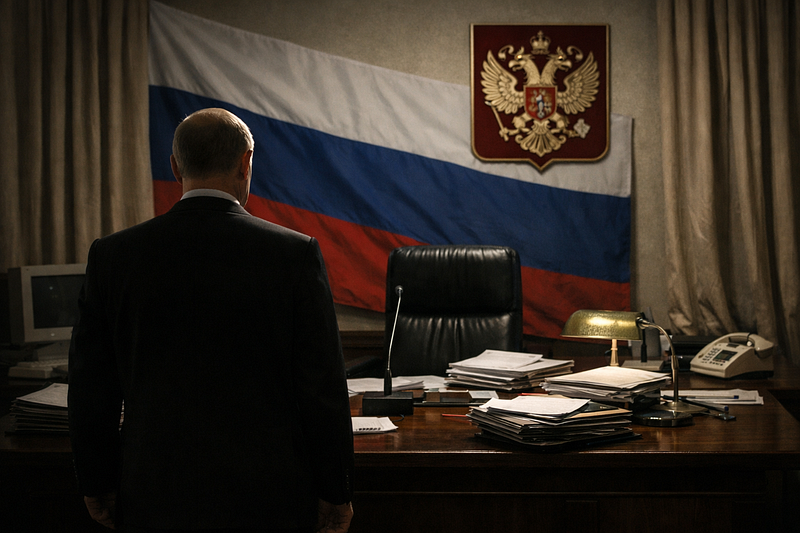
There was no crowd in Moscow. No square prepared for significance. No ceremony rehearsed. No anthem waiting to be played. There was only a desk, a camera, and a man speaking in a tone that did not seek witnesses.
Boris Yeltsin did not speak as someone under pressure. There was no urgency in his delivery, no defensiveness, no attempt to persuade. He spoke of fatigue. Of responsibility. Of knowing when continuation becomes liability. His words did not frame a crisis. They acknowledged a conclusion that had already been reached elsewhere.
He resigned.
Not after an election.
Not after a defeat.
Procedure continued.
He resigned on 25 December.
No interim measures were introduced. There was no pause in authority, no uncertainty, no procedural gap. In the same sequence, a successor was named. Vladimir Putin became Acting President of the Russian Federation with immediate effect. Full executive authority. Command over the armed forces. Control of the security services. Custody of the state.
Within hours, the legal mechanics followed.
A presidential decree was issued granting Boris Yeltsin and his family permanent immunity. It was not debated. Not delayed. Not framed as exceptional. It was processed as routine. Registered. Entered into record. Completed before most international desks returned from holiday programming.
The sequence mattered.
Authority transferred first.
Protection followed immediately after.
The entire process unfolded without friction.
No rupture.
No interruption.
No break.
What had been declared finished on 25 December 1991 was, eight years later, still operational. Not as ideology. Not as symbol. But as state.
What Had Not Disappeared
In 1991, the world had been shown an ending. Cameras lingered on symbols. A flag descended. A speech supplied closure. Commentators spoke of peace, of final victory, of a future released from history. The narrative was complete. An empire had collapsed under its own weight.
What followed was described as emptiness. As transition. As proof that the system itself had been exhausted.
But power does not dissolve into emptiness.
It repositions.
The security services did not vanish. They withdrew from visibility, changed names, reduced their public footprint. Their archives remained intact. Their personnel continuous. Their institutional memory undisturbed.
The military was not dismantled. It was neglected, underfunded, humiliated, but never dissolved. Strategic weapons were never opened to negotiation. Sovereignty at its core remained sealed.
Administrative layers persisted. Networks endured. Knowledge stayed where it had always been.
What appeared as collapse was, in many domains, latency.
The state did not fall apart.
It shed exposure.
The Nineties as Exposure
The 1990s are often remembered as failure. As chaos. As evidence that what came before could not endure. The description is not false, but it is incomplete.
Chaos does not only destroy.
Chaos reveals.
During those years, it became clear which regions could function without central authority and which disintegrated immediately. Which elites survived without protection and which collapsed overnight. Which institutions were decorative and which were structural.
It was a brutal period, but not a random one.
Control was loosened, not surrendered. The system was stripped down to essentials. What remained functional under pressure was noted. What failed was allowed to fail.
A state can tolerate exposure only temporarily. Eventually it must choose between dissolution and reconfiguration.
25 December 1999 marks the end of that exposure.
Not because problems were solved, but because enough had been learned.
A Transfer Without Narrative
What occurred that day was not accompanied by a new story. That absence was deliberate.
Major transitions usually announce themselves. They arrive with doctrine, language, justification. Even failed revolutions attempt explanation. Here, there was nothing of the sort.
No vision offered.
No direction proclaimed.
No promise made.
The language remained administrative, restrained, almost evasive. As if words themselves were a liability. And they were.
Narratives create expectation. Expectation invites debate. Debate introduces uncertainty. None of that was desirable.
This was not a beginning.
It was a termination.
The termination of a phase in which the state had allowed itself to be dismantled in full view.
The Correction of Visibility
Later, analysts would speak of a “return of the state.” The phrase implies absence. But absence had not occurred. What had changed was visibility.
Throughout the 1990s, the state was most visible where it failed. Empty shelves. Unpaid wages. Corrupt privatizations. Weakness was on display.
But power does not reside where failure is visible. It withdraws from those domains precisely to preserve itself elsewhere.
Core functions remained insulated. Territorial integrity. Strategic weapons. Intelligence. Archival memory. Long chains of loyalty.
The visible state failed.
The essential state waited.
25 December 1999 marks the moment when this imbalance was resolved. Not through reform, but through repositioning. The state did not need to become stronger. It needed to stop performing weakness.
That required authority, not rhetoric.
When the Room Appears
Only later does it become clear where this truly took place.
Not on a square.
Not in parliament.
Not in any public space where history is staged.
It happened in a room that showed no indication it was meant to be remembered.
No emblem had been repositioned. Nothing staged. Papers lay stacked without order. A chair stood slightly misaligned with the desk. Nothing suggested permanence.
Debate had already ended. Options had already collapsed into one. Words no longer persuaded; they merely confirmed.
No decision was made there.
What was registered was that nothing remained undecided.
This was not transition.
Internal legibility was restored.
The state became readable to itself again.
Western Misreading
What followed in the West was not analysis, but projection.
Commentators spoke of an unknown figure, of sudden ascent, of a former intelligence officer emerging unexpectedly. As if systems of this scale elevate individuals spontaneously.
The available data was sufficient.
The frame was not.
Observers searched for rupture where continuity operated. They searched for ideology where structure was doing the work.
The relevant question was not asked.
What, at all costs, had to be preserved?
The answer had little to do with one man.
After the Correction
What followed did not announce itself. It manifested not as doctrine, but as execution.
The state stopped speaking about itself.
It acted.
Decisions no longer required debate. Lines regained meaning. Boundaries returned. The sequence was deliberate. First internal consolidation. Then regional stabilization. Only much later, external visibility.
Subsequent events were framed as reactions. To humiliation. To loss. To chaos. But reaction implies emotion.
What unfolded was procedural.
The system resumed function in order. Visibility returned only when it no longer posed risk.
The West continued to speak of transition, of adaptation to a settled world order. Such language works only when the core has been surrendered.
It had not.
The state had learned how to endure exposure without dissolving. How to wait. How to remain unseen until action mattered again.
That process began here.
Closing
On 25 December 1991, an ending was made visible.
On 25 December 1999, continuity was formalized.
No announcement was required.
No explanation followed.
Status: continued.